

- The photo is part of the result.
- Separate an observation, an interpretation and an action.
- Choose a controllable experiment instead of chasing decimal changes.
A face score compresses many observations into a number. A looksmaxxing plan needs the detail behind it: facial proportions, symmetry, jawline, eye area and skin. Read the original photos and feature explanations together before deciding what, if anything, to change.
Use a feature-level report card
Separate each finding into what the image shows, what the model infers and what action is proposed. A low jawline score does not tell you whether the issue is beard framing, pose, light or a structural question. A skin estimate cannot diagnose the cause of a visible concern.
Keep the finding that leads to a specific, appropriate next step. For facial harmony, that could mean a framing comparison; for a persistent symptomatic concern, it could mean preparing an assessment question. Your action should follow from the explanation rather than from the rank of the number.
Check the input before comparing the output
A close selfie and a more distant portrait do not represent facial proportions in the same way. Research into photographed faces examines how camera distance changes perspective. Lighting, pose and expression add more reasons to be careful when comparing two photographs.
That does not mean every report is useless. It means that changing the setup makes a comparison harder to interpret. Keep a clear reference and note obvious differences before treating a score change as evidence of a change in you.
Sort the report into three layers
An observation describes something in the photo, such as the apparent outline of the hair. An interpretation suggests why it affects the overall look. An action proposes something to try. You can find one layer useful and remain unconvinced by another.
For example, you may agree that a hairstyle looks flat in a photo without agreeing that a dramatic new cut is the right answer. A smaller styling adjustment, a better photo or a conversation with your barber may be more relevant. Keep your own preferences in the decision.
- What can I actually see in this photograph?
- What is the report inferring from it?
- Which proposed action would I choose and why?
Pick an outcome that you can use
“Make the score higher” is hard to translate into a normal week. “Find a hairstyle I can maintain” or “compare two glasses directions” gives you a concrete outcome. You can evaluate whether the decision helped without needing every assessment to produce the same number.
Avoid using small movements in a score as a reason to repeatedly check your appearance. If a report stops helping you make calm, practical choices, step away from the comparison. The tool should serve your goals, not continually create new ones.
Ask a better follow-up
In MogRise, bring the specific observation to the Coach along with your time, preferences and constraints. Ask for a low-effort way to explore it, an alternative and what would count as a useful result. A focused question is easier to act on than asking how to change everything.
AI analysis is not a clinical assessment or an objective measure of your worth. For a medical concern, use an appropriate qualified professional. For style choices, a clear preference and an experiment you can reverse are often a more useful next step than another rating.
Read an AI face report in three passes
First, check whether the original photo is a useful input for the feature being discussed. Second, identify what the report appears to observe: a proportion, a contour, an eye-area frame or a visible skin concern. Third, examine the recommendation and ask whether it follows from that observation. Reading in this order stops the headline score from doing all the interpreting.
Keep the original portrait visible beside the report. If a finding is difficult to see, note that uncertainty instead of accepting it automatically. Some suggestions may still be useful prompts, but usefulness and measurement accuracy are different questions. Your goal is to find the detail that helps with a decision you can understand and reasonably evaluate.
Do not compare outputs with different definitions
A score out of ten, a percentile, an informal PSL-style label and an estimated angle are different forms of output. They may come from different models or definitions. Even when two tools use the same scale, that does not establish that the values mean the same thing. Record the tool, photo and output description before comparing anything.
For your own progress, favor a stable setup and a feature-level question. If the score changes while the hairstyle, light and camera distance also changed, the comparison cannot isolate a physical improvement. A result can still reveal a preferred presentation direction, but describe that outcome accurately rather than treating a number movement as proof of a transformation.
Audit an AI recommendation before adding it to the plan
A recommendation should have a recognizable job. Ask which observation it addresses, whether you can test it in ordinary life and which practical constraints it ignores. A haircut suggestion may not know how your hair behaves after washing; a beard image may assume coverage you do not have. Bring those constraints into the next conversation.
Sort the suggestions into test, ask and leave. Test a realistic framing preference. Ask for clarification when a term or relationship is unclear. Leave a suggestion that does not serve your goal. You can use the report selectively without turning it into a complete appearance checklist.
| Question | What to write down |
|---|---|
| What is observed? | The feature and the visible evidence in the original photo. |
| What is uncertain? | Photo conditions, unclear landmarks or missing real-world context. |
| What action follows? | A practical test, a follow-up question or an appropriate consultation. |
| What would count as useful? | A clearer preference or a specific question answered. |
Ask the Coach a narrower question
Replace ‘How do I fix everything?’ with the observation, goal and constraint. For example: ‘The report mentions lower-face framing. I prefer a shorter chin silhouette and trim twice a week. Which beard comparison would help me discuss this with my barber?’ This gives the conversation a clear area and avoids receiving another broad routine.
After the response, keep one action and one unresolved question. Check whether the action is realistic with your coverage, tools and schedule. The Coach can help organize your thinking, but the real-world fit still needs your judgment or an appropriate professional. A good report review ends with fewer decisions to make, not a growing folder of ratings from different photos.
Leave with the finding, its context and an appropriate next step.
Your score changed, but you need to know which facial observation is useful and whether the photos were comparable.
Read the explanation behind a jawline or harmony observation. Check it against both original views. Record anything the input may hide, such as beard coverage or directional shadow, then choose a question you can actually investigate.
From FaceScore to a feature-level decision
Use the prompts to turn this guide into your own next step. The examples are suggestions; write what fits your situation.
Review the feature-level explanation and the original input together. End with a concrete decision or an unanswered question to clarify.
Add a note to any prompt to continue. Your notes stay on this page. Download a text file before leaving.
A few useful clarifications.
01Can I compare my score across different apps?
Not as if the values were standardized. The models, scales and definitions may differ. Compare the purpose and supporting observations, and avoid treating unlike outputs as a shared measurement.
02What if I disagree with a recommendation?
Return to the original photo and the stated observation. Note your preference and practical constraints, then ask a focused follow-up or leave the suggestion. You do not need to implement every item in a report.
03What is more useful than a headline face score?
A feature-level observation you understand, a realistic action and a review question. Those details help with a haircut, beard, glasses or routine decision even when the score itself is not useful.
Where your next question leads.

Facial harmony: read the relationships between your features.
Understand facial thirds, midface, symmetry and profile balance. Learn what a face analysis can show and how to use it in looksmaxxing.
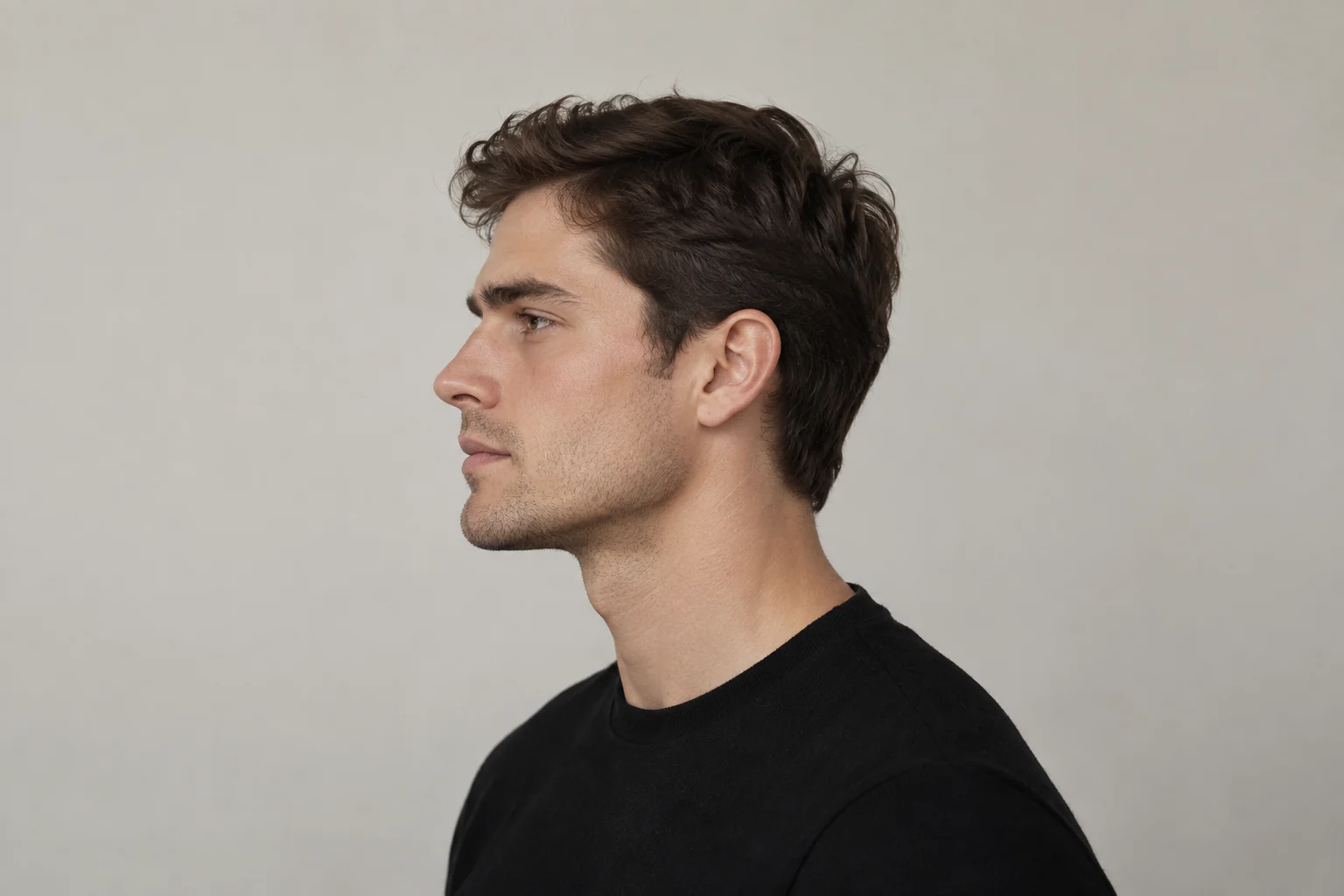
Jawline definition: separate structure, framing and the photo.
Understand jawline definition, chin and profile balance, beard framing and mewing claims before choosing your next looksmaxxing step.

How to looksmaxx: a beginner’s guide to your first plan.
Learn how to looksmaxx with a face audit, clear priorities and practical steps for facial harmony, jawline, eyes and skin. Build your first plan.