
How to fold a sweater for everyday storage
Learning how to fold a sweater is useful when the result fits the place where you actually keep it. This guide uses one loose, supported fold for an ordinary pullover, then checks whether you can put it away and retrieve it without pulling the whole space apart.
Begin with one clean, dry garment whose care instructions allow ordinary folded storage. You do not need a folding board, matching boxes or a new wardrobe. A clear flat surface and a destination with enough room are more useful than copying the dimensions of a shop display. Use the garment’s own instructions when they differ from a general tutorial.
This is a storage task, not a washing, drying, ironing, stain-removal or repair method. If the pullover needs one of those jobs first, keep that decision separate. Folding cannot correct a care problem or restore an item that no longer fits.
Pick the destination before making the folds
Open the drawer or identify the shelf you intend to use. Notice the available depth and width, any rough edge and whether another object will press against the garment. You are looking for a place where a folded item can rest and be lifted normally, not trying to fill every empty space.
For a shallow drawer, a broad, low bundle may work better than a small tall one. On a shelf, a visible short stack may be easier to reach than several layers hidden behind each other.
If you keep postponing this small job, give it a clear boundary: put away one ready-to-store pullover. The guide to a plan that fits your life can help you turn a vague wardrobe project into a manageable action. You can complete the fold independently without any app.
Check that the garment is ready
Look at the care label and the item itself before laying it out. Follow any special storage or handling instructions. Do not put away a damp garment as though folding were another drying stage. If you are unsure whether recent care is complete, finish that process according to the label or ask the appropriate care professional.
Empty any pockets and remove objects that could become trapped between the layers. For this basic route, choose a pullover without a hood, rigid decoration or an awkward closure. Those features may need a different arrangement, and there is no advantage in forcing them into this example.
Notice whether you are confusing storage with fit. Pulling a cuff or stretching the body while folding does not solve a sizing issue. Our wardrobe fit audit helps you examine the worn garment separately. Keep this session about putting an already suitable item away.
Lay it flat and contain the sleeves
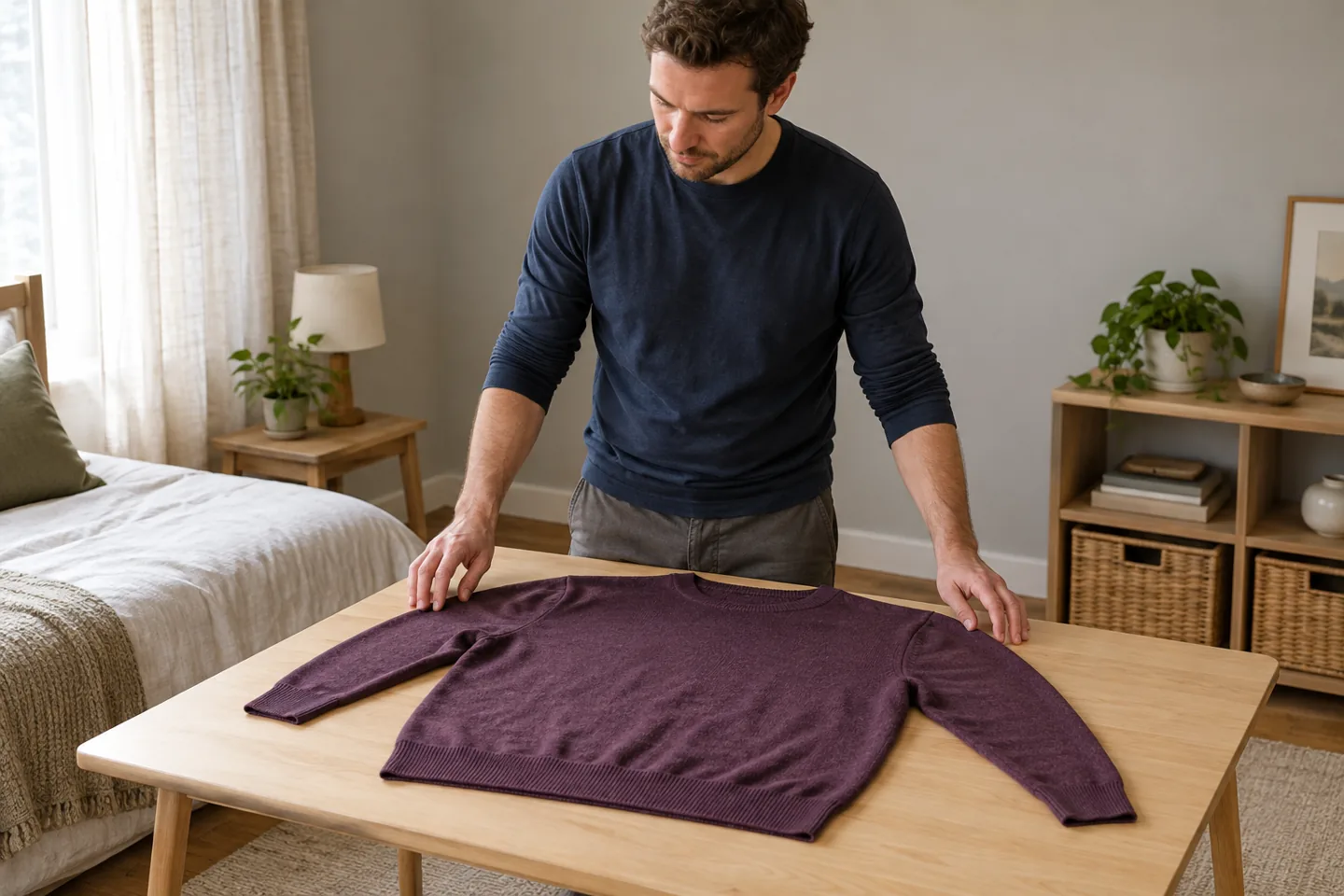
Place the pullover front down on a clear, smooth surface with the back facing you. Let the sleeves and body rest naturally. Guide each sleeve inward onto the back, bending it as needed so the cuff stays within the body’s length. Support the fabric rather than lifting the whole item by a cuff.
The illustrated jumper section in C&A’s folding instructions provides a useful reference for the basic flat arrangement. We use the simple route, not its promises of a universally crease-free wardrobe or its additional shopping suggestions. The destination and this particular garment still matter.
Before continuing, check whether one sleeve is rolled into a thick cord or caught under the other. Open that part and lay it down again. A small natural ripple does not need repeated correction.
Bring the sides inward without pulling
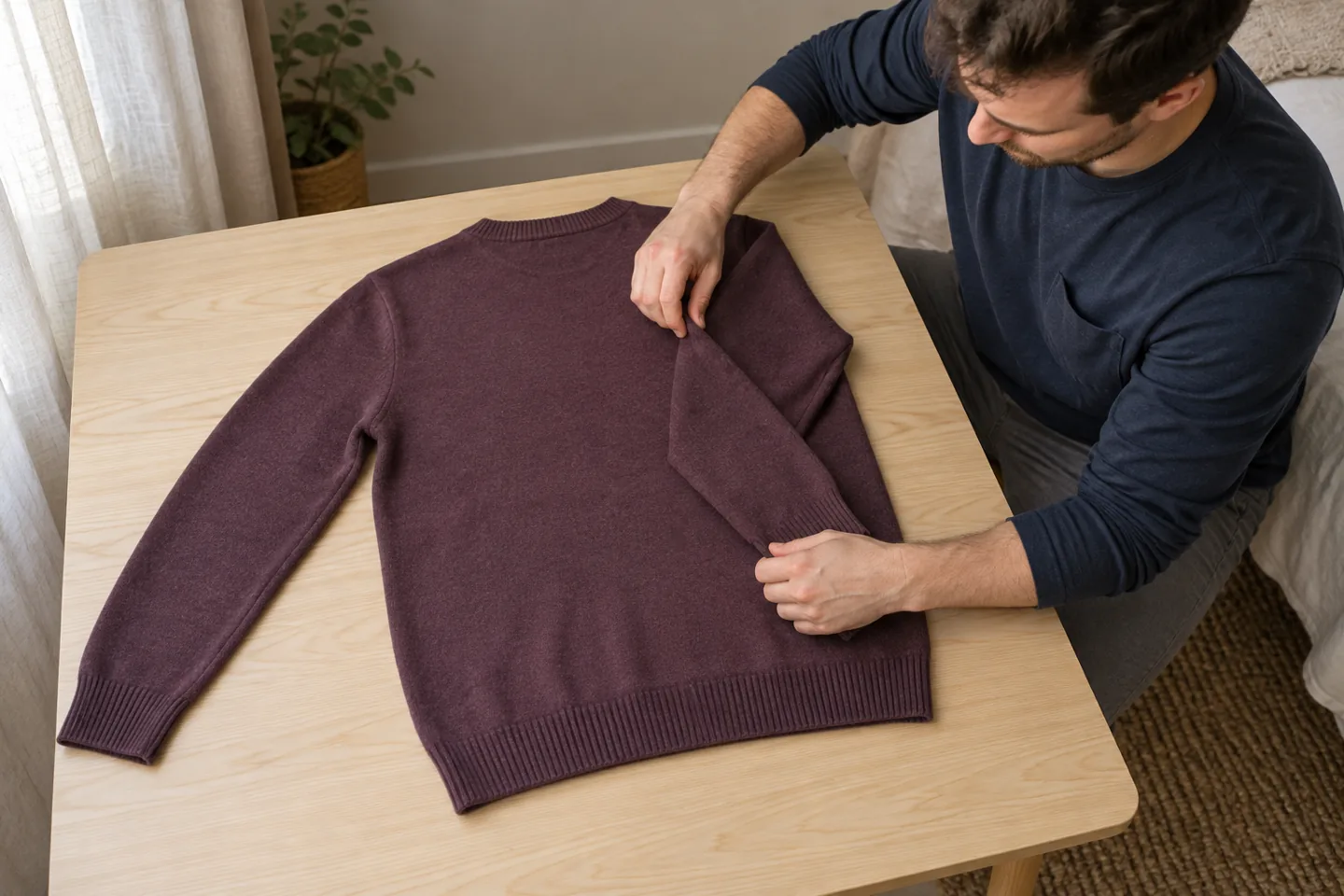
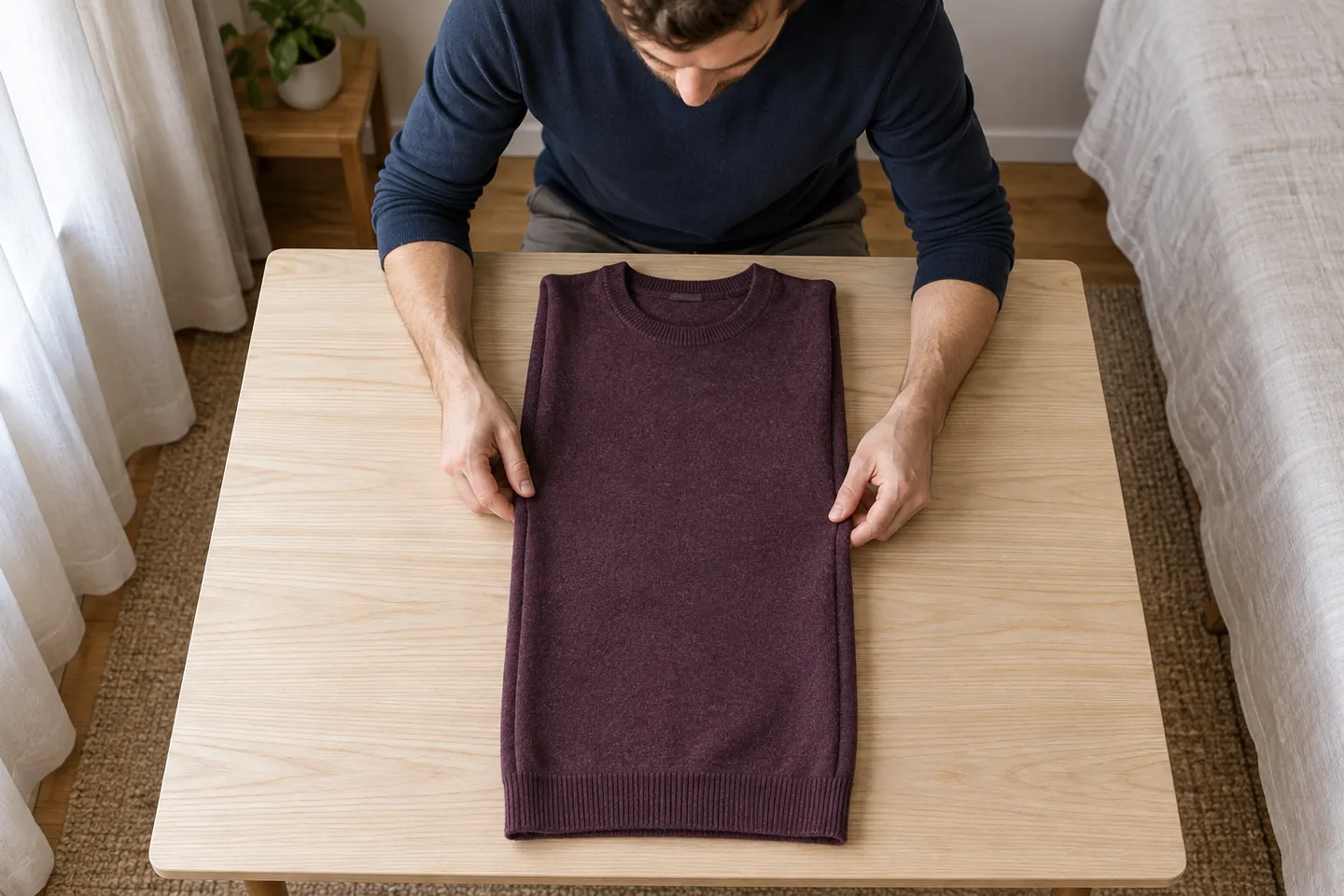
Turn one long side of the body toward the centre, moving the shoulder area and hem together. Repeat on the other side to form a long rectangle with the sleeves contained. Keep the neckline resting naturally and avoid dragging it sideways to make the edges match.
Choose a width that has a chance of fitting your intended space. It does not have to be exactly the same width as another sweater. If a sleeve peeks beyond the edge, adjust that sleeve rather than narrowing the whole package until the fabric bunches.
An example helps: if the first side lies flat but the second side produces a mound near the shoulder, reopen only the second side. Settle its sleeve and fold again. There is no reason to restart the part that already works, or to press down harder in search of a perfectly sharp rectangle.
Shorten the rectangle with a loose fold
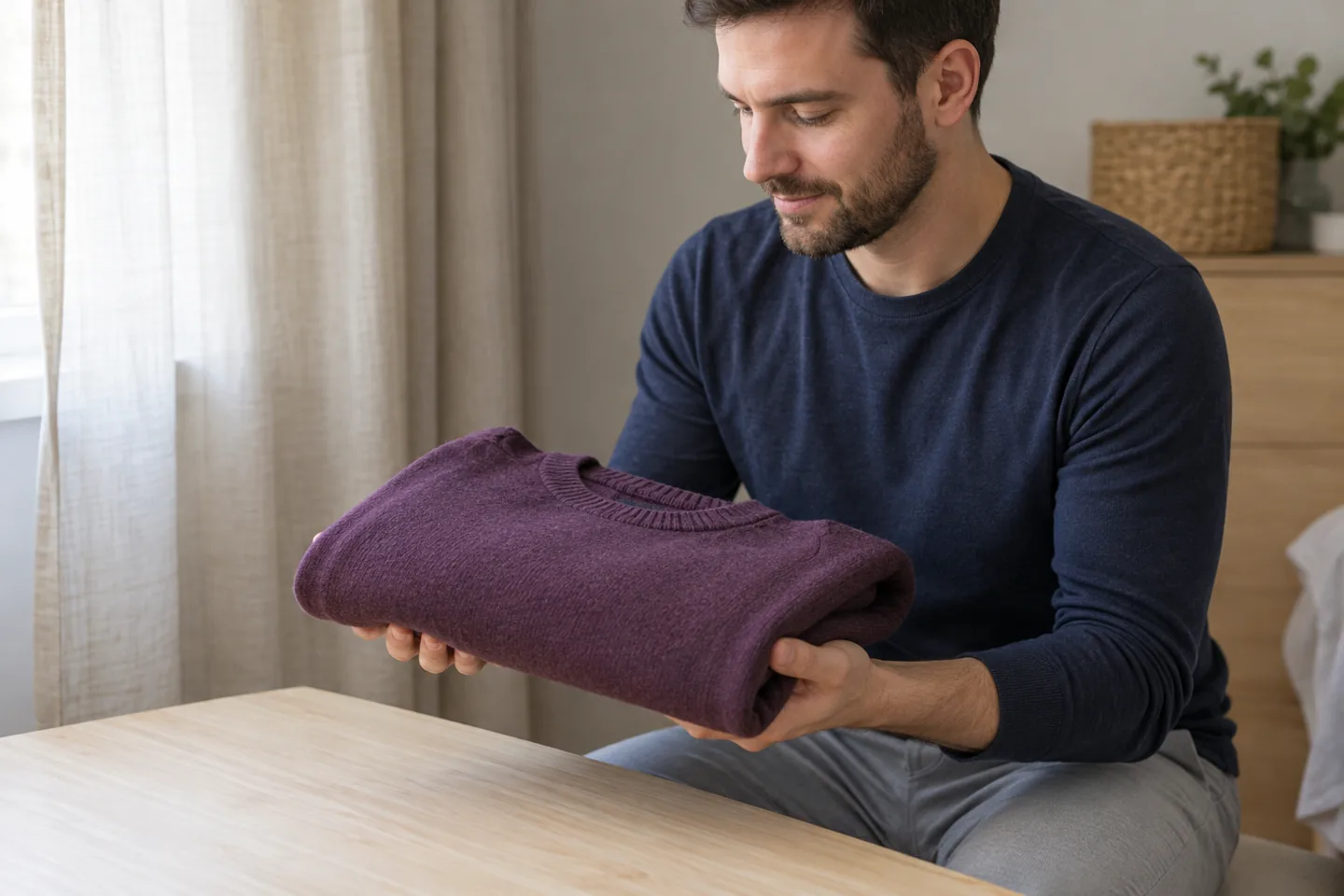
Bring the lower portion upward toward the shoulder end, supporting the body as it moves. Let the fold remain broad enough for the thickness of the knit. Check whether the resulting length fits the shelf or drawer before adding another fold.
A lighter pullover and a bulky one do not have to make identical bundles. If the thicker garment becomes a tall lump, try a broader arrangement or another suitable storage position. Do not solve an overfilled space by squeezing the item into the smallest possible shape.
Imagine a drawer that closes easily while empty but catches the folded sweater. Take the garment out and inspect the available height. Repositioning or reducing what shares the drawer is clearer than repeatedly pushing the front closed. You should be able to complete the movement without catching a sleeve in the runners or the closing edge.
Move the folded item with support
Slide your hands under the folded body and lift it as a unit. Keep the sleeves inside the fold rather than letting them hang from the edges. This makes the transfer easier to control and lets you see whether the chosen arrangement remains together during an ordinary move.
If the bundle opens immediately, place it back on the surface and identify why. Perhaps one sleeve was never contained or the final fold barely overlapped. Correct that detail before trying again. The answer is not automatically another tight fold.
For a large pullover, bring the working surface closer to the storage area if that is practical. Avoid balancing the garment on one hand while using the other to move a crowded stack. Clear the route first.
Use a drawer without forcing a filing system
Set the sweater in the drawer and test its resting position. A flat arrangement is a reasonable starting point. If you prefer an upright file, use it only when the folded item sits comfortably within the available space without being tightly wedged between neighbours.
A method that looks tidy in a photograph can still be inconvenient for your actual drawer. Check whether you can see the item, reach it and close the drawer gently. If a collar or cuff becomes trapped, change the arrangement. Do not pull harder on the exposed edge to retrieve the garment.
You do not need to buy dividers before checking these basics. Try the space you have with one garment first. If a divider would solve a specific problem later, assess its surface and fit separately. Organisation equipment is an option, not a prerequisite for folding.
Keep a shelf stack accessible
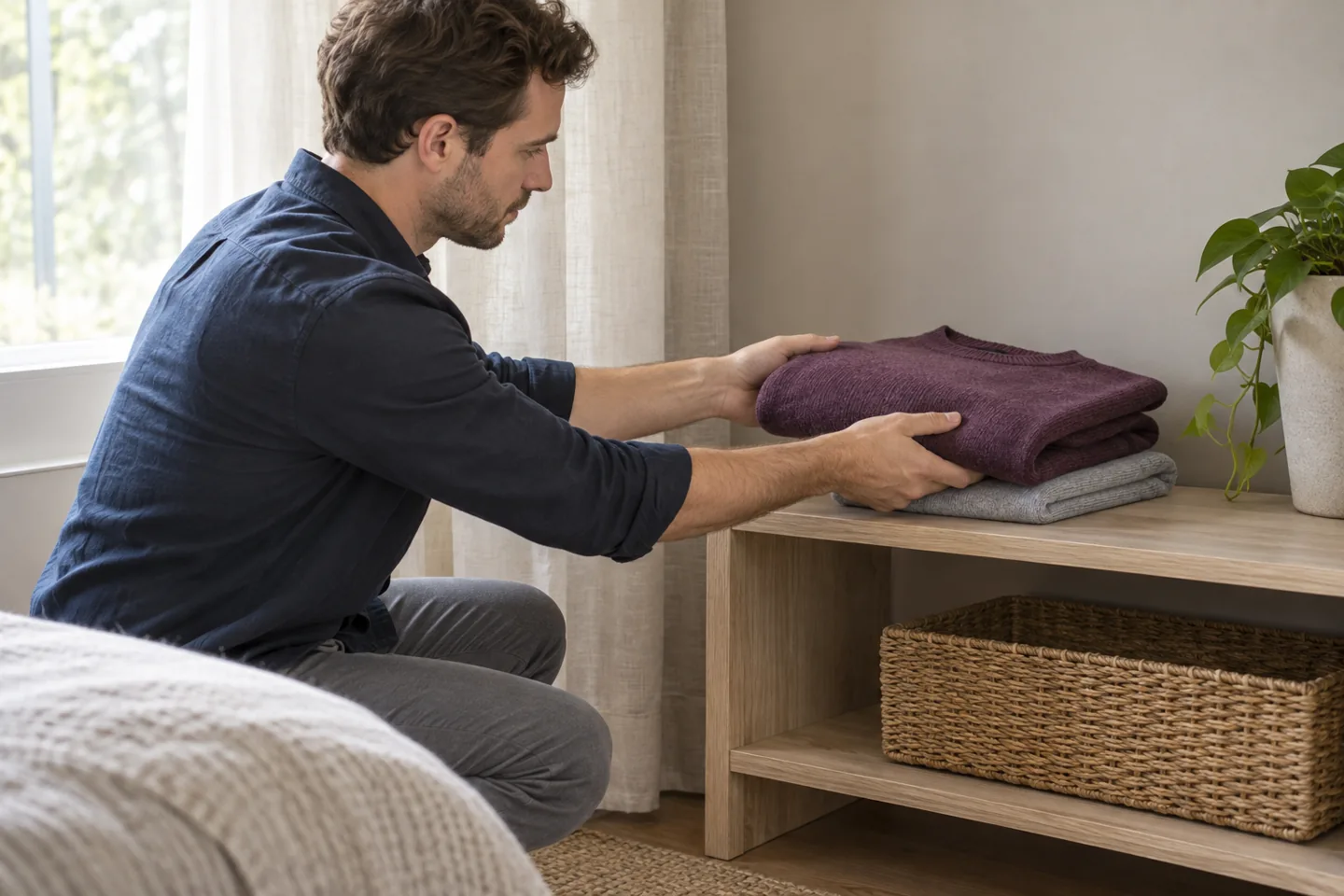
On a shelf, place the folded sweater where it can rest fully on the surface. Avoid leaving part of the body hanging over the front simply to make room for something behind it. A shelf that is too shallow for this fold may need a different fold or another destination.
Build only a stack you can manage with your available space. There is no fixed number that works for every thickness, shelf or person. If removing one item makes the remaining pile unstable, reduce the stack or move frequently used garments to a more accessible position.
For example, keep the pullover you plan to wear next near the top rather than burying it under rarely used pieces. You should not need to reproduce a retail display every time you get dressed.
Test retrieval once, then leave it alone
Put the garment away and take it out once using support under the folded body. On a stack, move the items above it carefully rather than dragging a middle layer out by the cuff. Return the sweater and check that the storage space still works normally.
If the test is awkward, name the issue: too little room above, a hidden item, an overhanging edge or a sleeve escaping the fold. Change the relevant detail. A functional observation gives you more useful information than judging whether the pile looks perfectly symmetrical.
Our guide to tracking style without overthinking offers a helpful boundary for appearance-related tasks. Check the practical question and stop once it is answered.
Adapt carefully for unusual shapes
A high collar, large cable pattern or unusual sleeve shape may need more room around the fold. Work with the garment’s own construction and instructions. Do not flatten a structured detail just to make it resemble a plain crewneck pullover in an illustration.
For a zip, buttons or decorative elements, first consider where those parts would sit between layers. If they create an awkward pressure point, choose another arrangement or seek guidance for that item. This article does not prescribe a universal fastening or packing method for every knit.
If you discover a snag, an open seam or a care question, set the garment aside for the appropriate next step. Do not pull a loose thread, cut it or attempt an unfamiliar repair as part of the folding routine. A paused storage task is better than turning a small practical job into an improvised alteration.
Finish with a repeatable place
Leave the ready garment in a position you can remember and access. Put away anything used to clear the working surface. The routine is complete when the sweater has a suitable resting place and you know how to retrieve it, not when every other drawer has been reorganised.
Keep one useful lesson from the attempt. Perhaps a wider fold suits this shelf, or the bulky item belongs on a different level. Apply that observation to the same garment next time instead of imposing identical dimensions on everything you own.
A workable fold can remain ordinary. It does not need an app, a specialist board or a perfect stack. Choose a manageable finish, preserve the garment’s care requirements and get on with the rest of your day. Revisit the setup only when it stops meeting a real need.
Frequently asked questions
Should every sweater have the same folded size?
No. Thickness, construction and storage space differ. Use a fold that rests comfortably and can be retrieved normally. Matching rectangles are not more important than a suitable arrangement for the actual garment.
Can folding replace drying or ironing?
No. Finish any required care according to the item’s label before storage. Folding is not a drying stage, a stain treatment or a way to remove existing care problems. Keep those decisions separate.
Is upright drawer storage always better?
Not necessarily. Test whether this item sits without being wedged or caught and whether the drawer closes normally. A flat position or another suitable space may be easier for a bulky pullover.
What if the folded bundle keeps opening?
Return it to the surface and check the sleeves and final overlap. Adjust the part that escapes rather than automatically tightening every fold. If the garment’s shape resists the method, choose another arrangement consistent with its care instructions.