
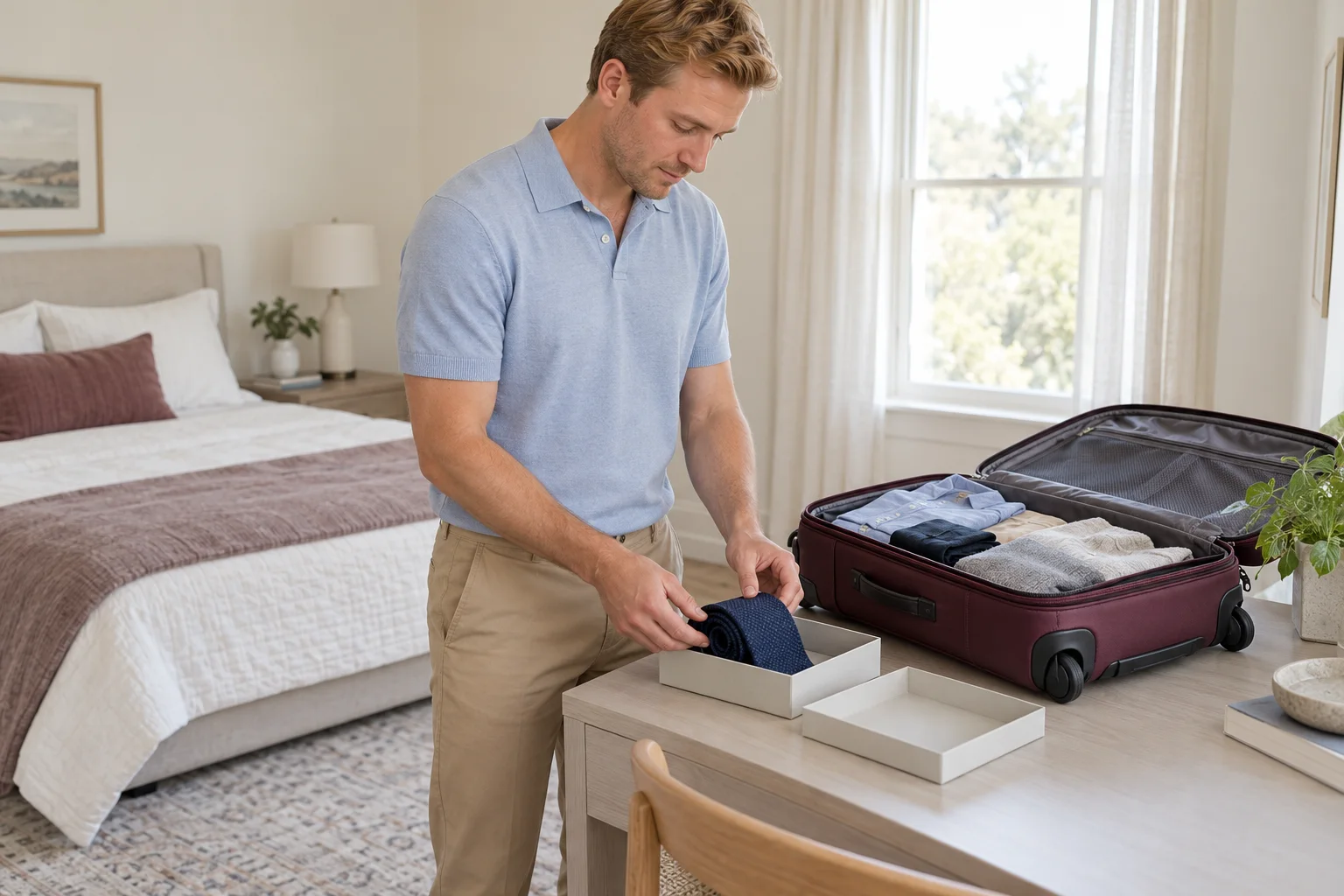
how to pack a tie
Knowing how to pack a tie starts before the suitcase closes. An existing necktie needs a clean place, an undone knot and protection from the heavier things travelling beside it. A compact roll can help organize that space, but it does not make every fabric resistant to creasing. The care instructions for your particular tie remain the starting point. This guide concerns packing a conventional untied necktie, rather than cleaning it, altering it or repairing damage.
Imagine packing for an evening event after a train journey. Your shirt is ready, your shoes have their own space and you want to use a tie you already own. The useful question is where that tie can sit without being squeezed when the case is shut. You can answer that with an existing clean box or suitable case, without buying another travel accessory. Allow time to unpack at the destination rather than assuming a particular arrangement guarantees a perfect result.
How to pack a tie begins with the actual piece
Read the attached care information and any instructions supplied by its maker. Woven silk, knitted construction and unusual decorative details may need different handling. If the maker specifies a particular storage arrangement, follow that guidance instead of treating a general rolling method as universal. A damaged seam or loose decoration is a reason to choose another tie or seek appropriate advice; luggage preparation is not an opportunity to experiment with repairs.
Inspect the piece in ordinary room light on a clear surface. You are looking for practical obstacles, such as a damp patch, an existing knot or something that could snag. You do not need a magnifying inspection or a photograph of every fold. Once the relevant decision is made, continue packing. Repeatedly checking the same fabric will not create more usable space in your case.
The LOUIE tie-care guidance in Brazilian Portuguese describes rolled storage and a protective box for luggage. That supports the storage choice here; it does not establish a guarantee about your particular fabric.
Undo the knot before finding its place
Take the tie off completely and loosen the knot gently. Support the fabric near the knot while working it open rather than yanking the narrow end through resistance. Leave yourself a little time for this step after wearing the tie. Keeping a ready-made knot for the next morning may seem convenient, but it also leaves a concentrated folded section inside your luggage.
If the knot will not release with gentle handling, stop rather than pulling harder. Use another suitable tie for the trip and ask the maker or a competent clothing-care professional about the stuck one. This article does not prescribe soaking, lubrication, heat or an improvised tool. The packing task can still be completed without solving every clothing problem on the same evening.
Prepare a clean, dry surface
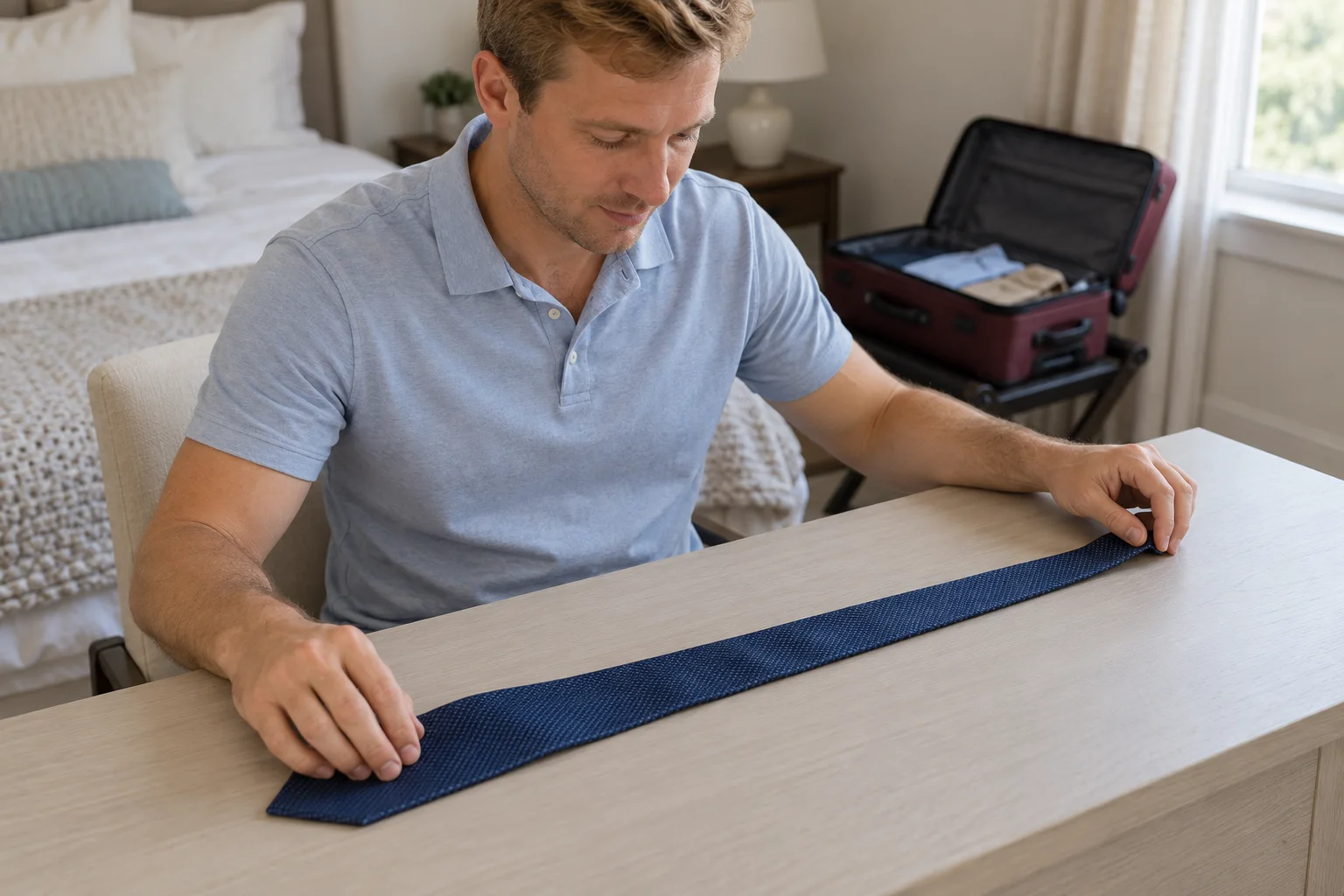
Clear a desk or table before laying the tie down. Remove drinks, toiletries and rough objects first. A clean surface makes the full length easier to support and reduces the chance of dragging it across something unsuitable. Avoid packing directly next to an open bottle while trying to hold the fabric in the other hand.
Place the tie flat without stretching it. Check that the surface is large enough to handle the length comfortably. If it is not, move to a better place instead of leaving the tip dangling against the floor. Keep the task ordinary: this is a short preparation step, not a measurement exercise or a judgment about whether the accessory looks expensive enough.
If you are still choosing what to take, the wardrobe fit audit can help you work with existing clothes.
Form a loose roll without squeezing
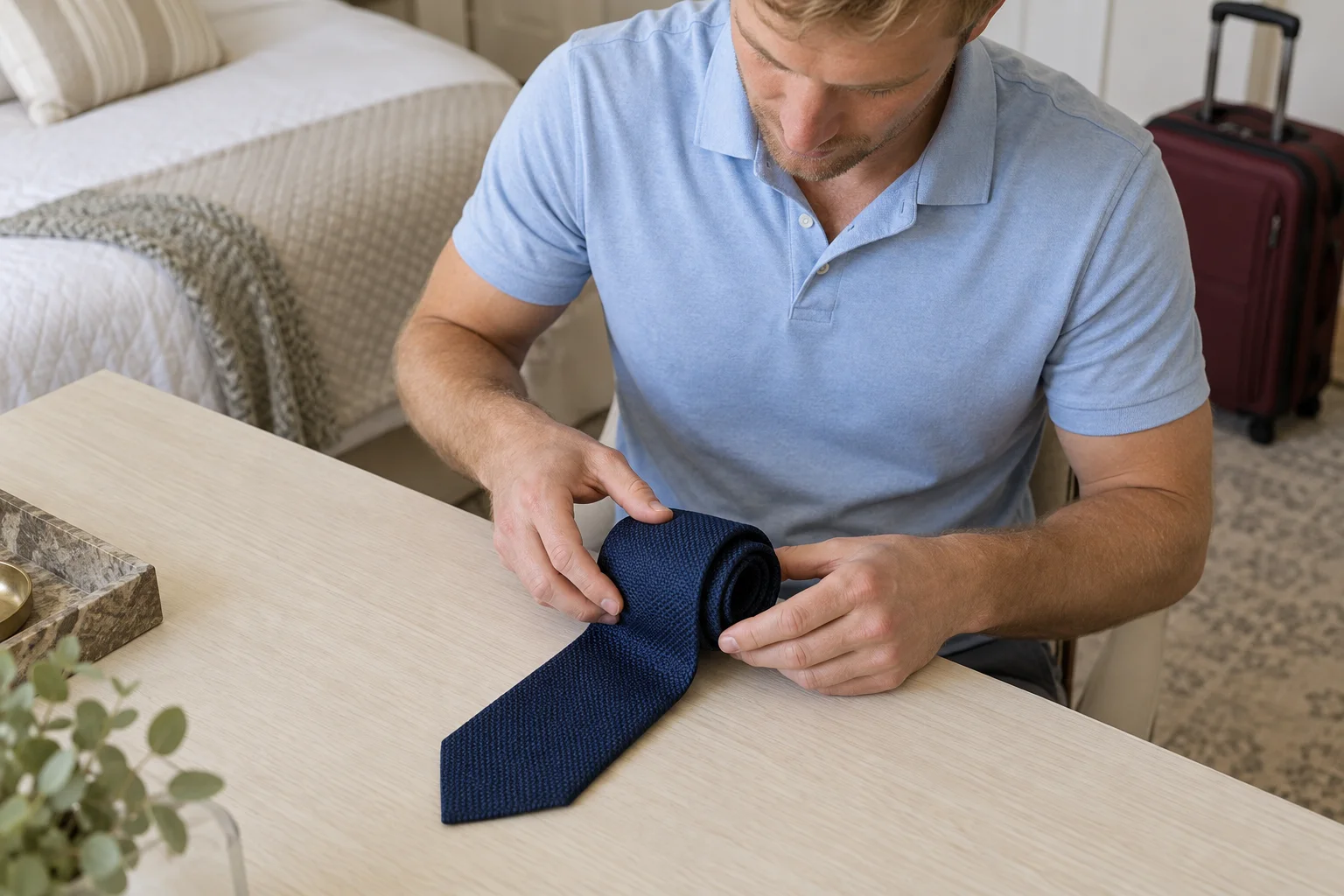
Bring the fabric into a broad, gentle roll, supporting it as you go. Avoid making a hard, tightly wound core merely to reduce its size. You should not need to pull the fabric taut, press down on the edges or hold the finished roll together with a tight elastic band. If the roll immediately opens, a larger protective space may be more suitable than a tighter wrap.
Leave room for the actual shape. A knitted tie or an unusually thick construction may occupy more space than the thin woven example shown in the photographs. Images illustrate handling and placement; they do not establish a required diameter or a fabric-specific guarantee. Use the maker's instructions to resolve an uncertainty about construction rather than copying a photograph precisely.
Choose protection that fits the roll
Look for an existing clean box or an appropriate travel case. Check the inside for rough edges, loose hardware and residue before adding the tie. The lid should close without pushing the roll into the sides. A container that needs pressure to shut is too small for the arrangement you have made, even if its outside dimensions fit an attractive gap in the suitcase.
Try closing the empty container first so you understand how its lid moves. Then place the tie inside and close it gently. Do not catch a length of fabric between the lid and the rim. If that happens, reopen the container completely and rearrange the contents. Pulling the exposed tip while the lid stays closed can turn a minor packing adjustment into avoidable strain.
Place it where the luggage will not press
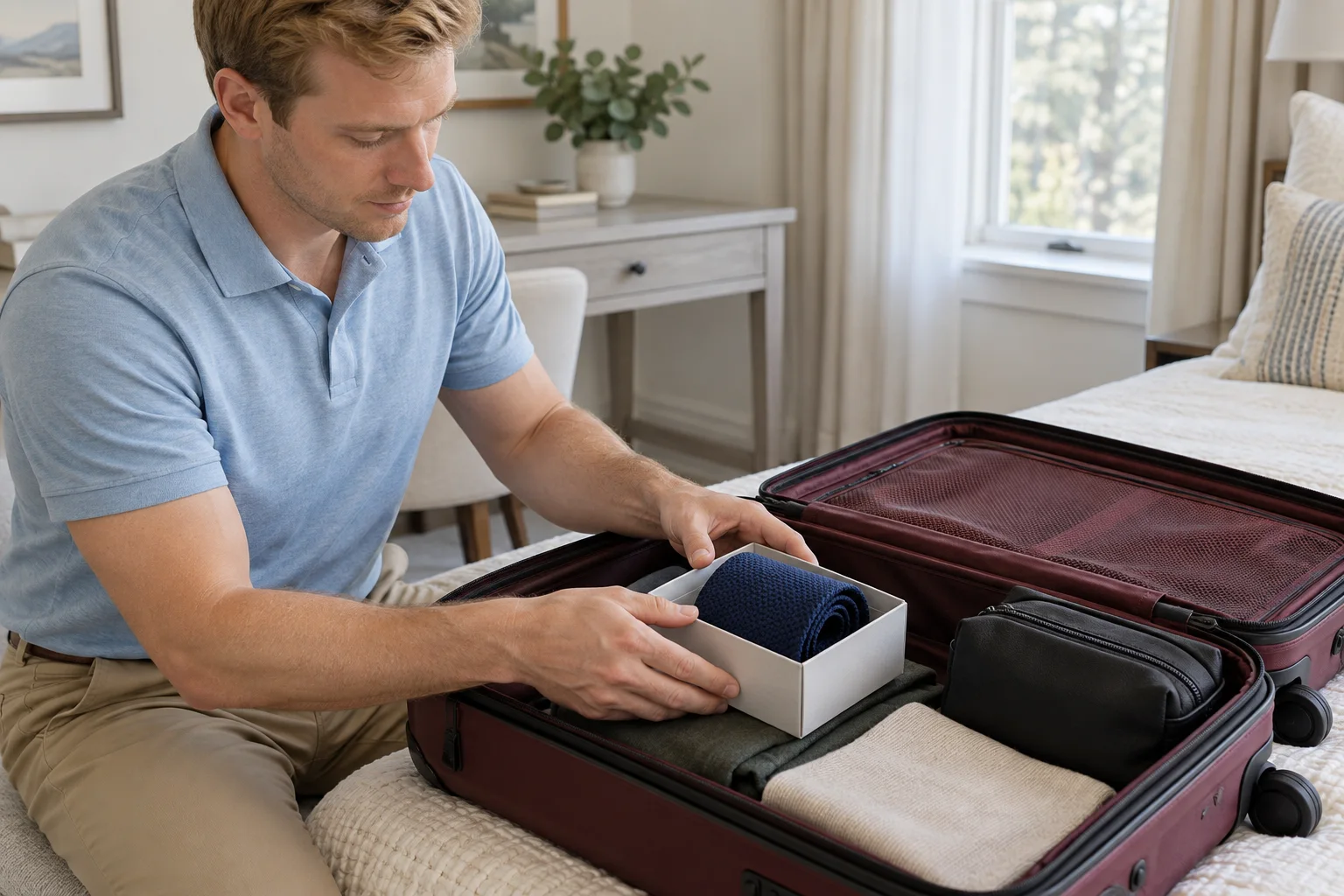
A protective box still needs a sensible position. Place it where surrounding contents support its location without bearing down on the lid. Keep shoes, hard chargers and heavy toiletry containers from moving onto it. Close liquid containers properly and keep them in their separate appropriate storage; a tie box is not a spill-proof barrier.
Before closing the case, check its overall fullness. If you have to sit on the lid, squeeze the corners together or pull the zipper against substantial resistance, rearrange the luggage. Moving the tie into a smaller container does not solve a suitcase that is already overfilled. Taking one less accessory can be a more useful decision than finding another packing trick.
Consider what you will need during the journey. If your charger is underneath the tie box and you expect to retrieve it on a train, move it now. A protected arrangement only helps while it stays in place. Put frequently needed objects somewhere accessible so reaching them does not require removing and replacing the tie several times.
Close once, then leave the arrangement alone
Check that the box is closed, no fabric is caught and nothing heavy rests on top. Bring the suitcase lid down slowly. Ordinary light contact is different from forcing an overfilled case; if the lid does not close normally, reopen it and remove the source of pressure. The aim is a workable arrangement, not a test of how much the container can withstand.
Once the case closes comfortably, move on. There is no need to reopen it repeatedly to verify that the roll still looks identical. Normal travel can shift contents and some creasing remains possible. Planning a little unpacking time is more realistic than promising that a particular box will preserve every curve in the fabric.
Allow a calm dressing sequence using the simple morning routine rather than adding repeated checks.
Unpack before you need to dress
At the destination, put the case on a stable surface and remove the tie container before unloading heavier objects around it. Open the lid fully. Lift the tie with support rather than tugging a visible end out from under another item. Let the roll open naturally on a clean surface or follow the maker's recommended hanging arrangement.
Check the tie in normal room light. If there is a minor mark from packing, do not immediately reach for a hot iron or hold it over steam. Care methods differ, and an improvised treatment can introduce a separate problem. Ask the maker or a suitable clothing-care service if its instructions do not resolve the issue. A backup accessory is a practical option when time is short.
This article deliberately stops at preparation and unpacking. It does not provide stain-removal instructions, a heat setting or a promise that hanging will remove every crease. Packing more carefully can reduce unnecessary pressure; it cannot change the material or reverse existing damage.
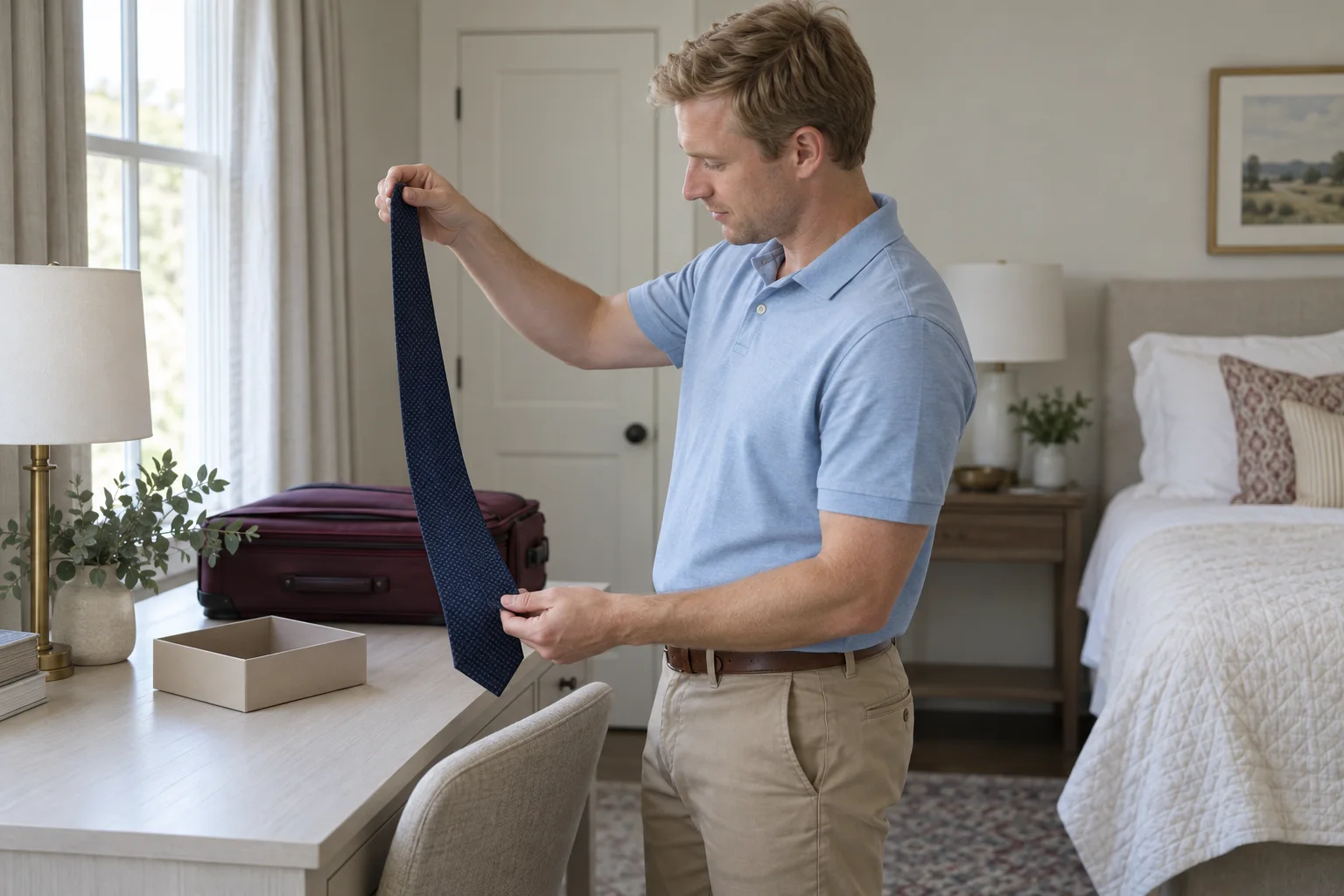
A simple example for an overnight trip
For a one-night visit, choose the tie that already works with the shirt you intend to wear. Untie it, check its care information and lay it on a clear desk. Make a gentle roll and place it in a clean box with enough room. Put that box in an uncrowded section of the case, separated from shoes and toiletries. Keep the charger you will need on the train in an accessible pocket.
At arrival, take the tie out while unpacking rather than leaving it until the last few minutes before the event. If something has shifted, evaluate the actual condition without turning it into a judgment about your appearance. You can use a different accessory or seek appropriate care advice. The successful routine is the one that helps you get ready calmly with the belongings you have.
Questions before the next journey
Do I need to buy a special tie case?
Not necessarily. An existing clean container may be sufficient if it supports the tie without squeezing and closes without catching fabric. A dedicated case is an option rather than a required purchase. Check its actual internal space and instructions; a product name alone does not establish suitability for every tie.
Can I leave the knot tied for convenience?
Undo the knot before packing. Make time to tie it again when getting dressed, using a knot you already know. If you are unfamiliar with tying it, practise at home before the trip rather than storing a tight knot throughout the journey. Do not force a stuck knot just to finish packing quickly.
Does rolling guarantee a wrinkle-free tie?
No. Different construction, the tie's condition, luggage pressure and movement can affect the result. A loose roll with suitable protection is a practical storage approach, not a guarantee. Follow the maker's guidance and leave time to inspect the piece after unpacking.
What if the only available space crushes the box?
Change the packing arrangement or leave an unnecessary item behind. A box that is visibly being compressed is not an appropriate place for the tie. Do not try to compensate by rolling the tie tighter or wedging its ends into a corner. The available space should accommodate the piece, rather than requiring the piece to withstand the space.