
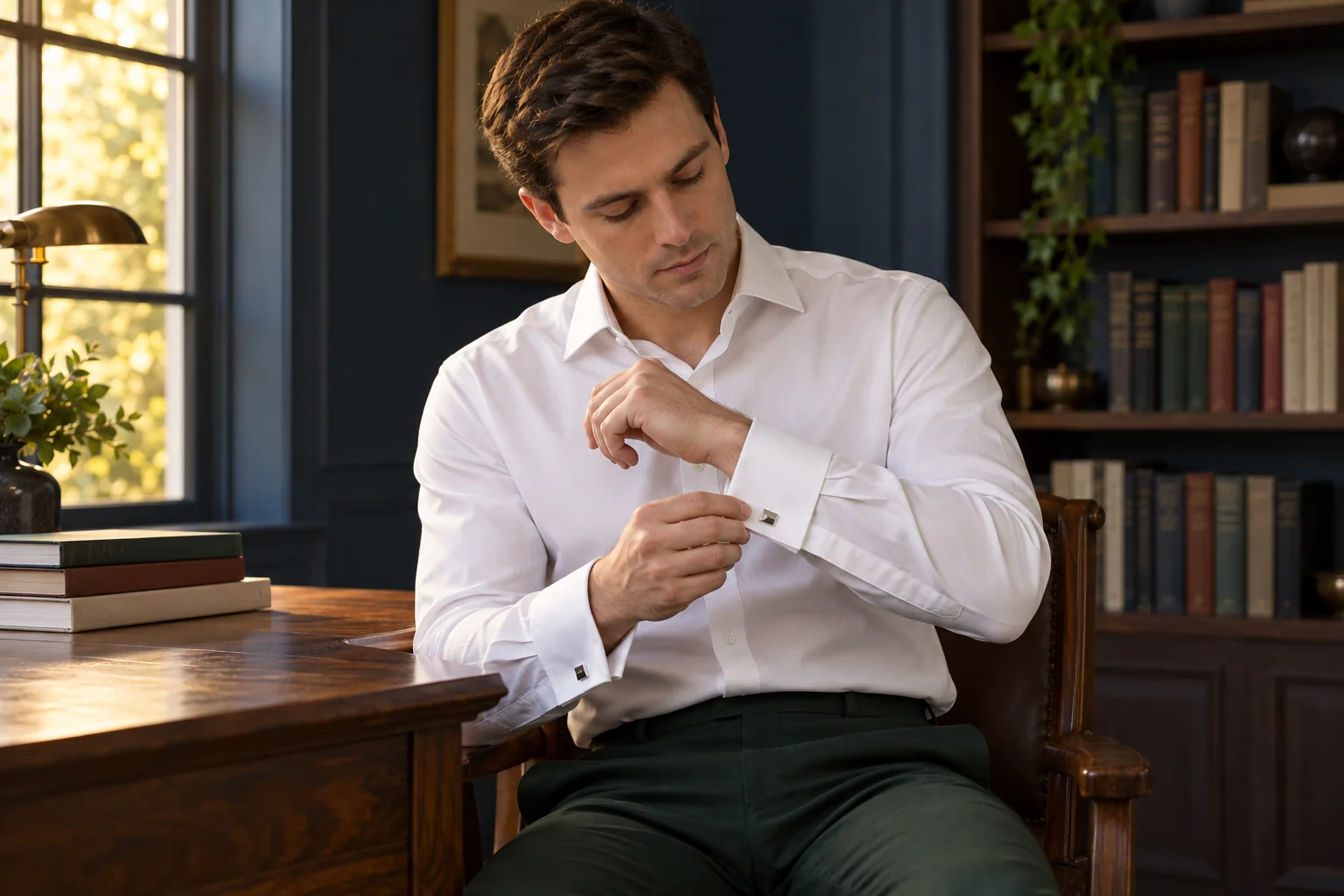
How to put on cufflinks with a clear sequence
Learning how to put on cufflinks is easier when you separate the shirt, the fastening and the final comfort check. A cufflink is a small mechanical accessory, not a test of how formal, successful or attractive you are. The practical question is whether the pair you own works with the cuffs you have and can be fastened without pulling the fabric or making your wrist uncomfortable.
This guide uses a folded-back French cuff and a cufflink with a pivoting rear bar. Other cuff constructions and fastening designs need their own instructions. Keep a normal button-cuff shirt as a perfectly valid alternative if the pieces do not match. MogRise can optionally help organize preparation through existing personal plans, daily actions and Coach questions. It cannot inspect the mechanism, identify a shirt from this article or certify a comfortable fit.
Identify the cuff before opening the accessory
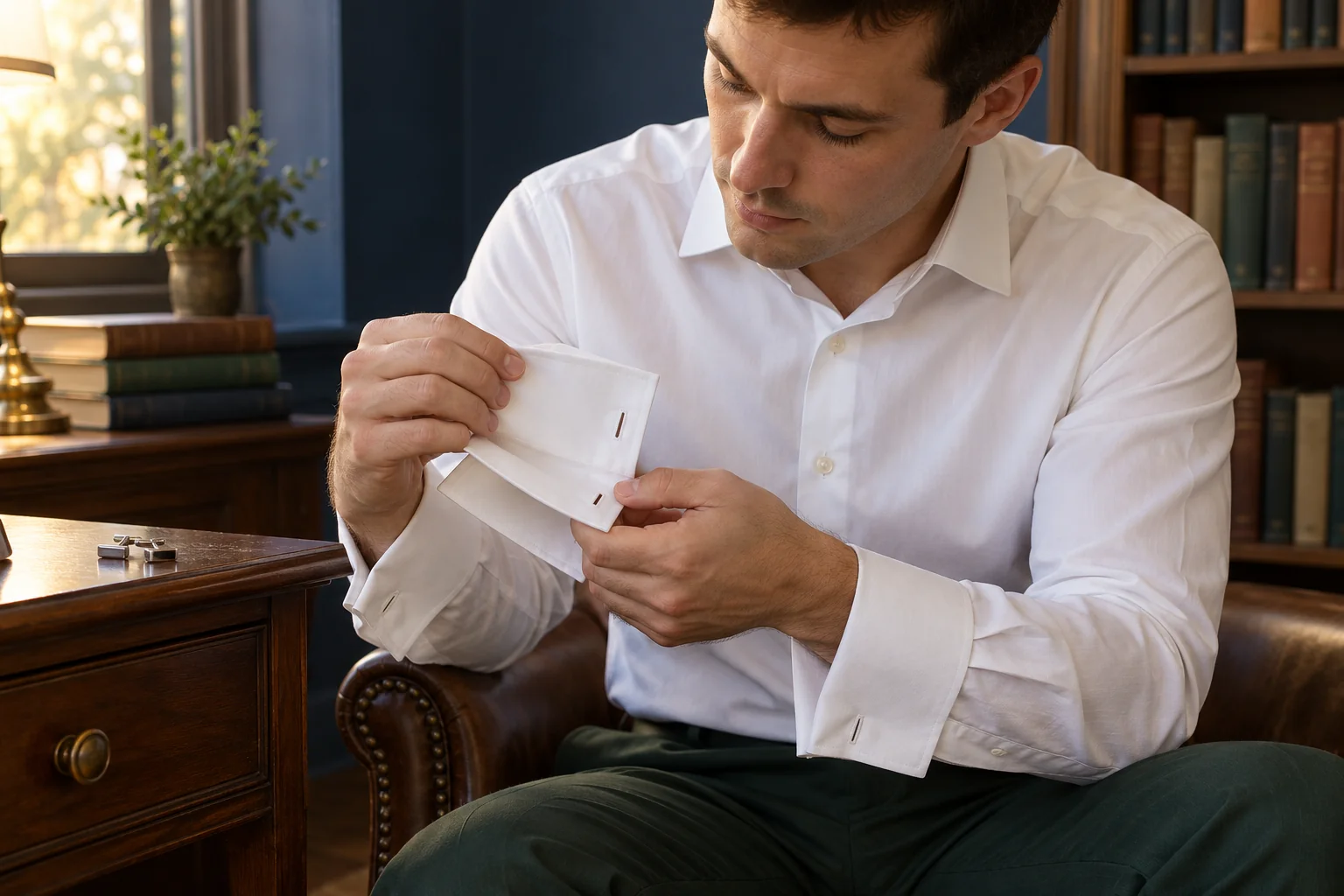
Look at the actual shirt, preferably while it is easy to handle on a clean surface. A French or double cuff folds back on itself and is intended to be fastened with cufflinks through its corresponding openings. Do not assume that every long shirt cuff has this construction. An ordinary sewn-button cuff may need to remain fastened with its own button.
The Charles Tyrwhitt cuff guide explains the folded-back construction of its French cuffs. Use that distinction to identify the task, rather than adopting the page's styling or occasion recommendations as obligations. A wedding, an office or a dinner does not establish which fastening your particular shirt can accommodate.
Check both sleeves so that a missing opening, an unusual construction or an unclear fold does not surprise you halfway through getting dressed. Follow the shirt maker's guidance where necessary. Do not cut a new hole, remove a sewn button or force a cufflink through the fabric to make a mismatch work. Choosing a different compatible shirt is a complete practical decision.
Understand the fastening you actually have
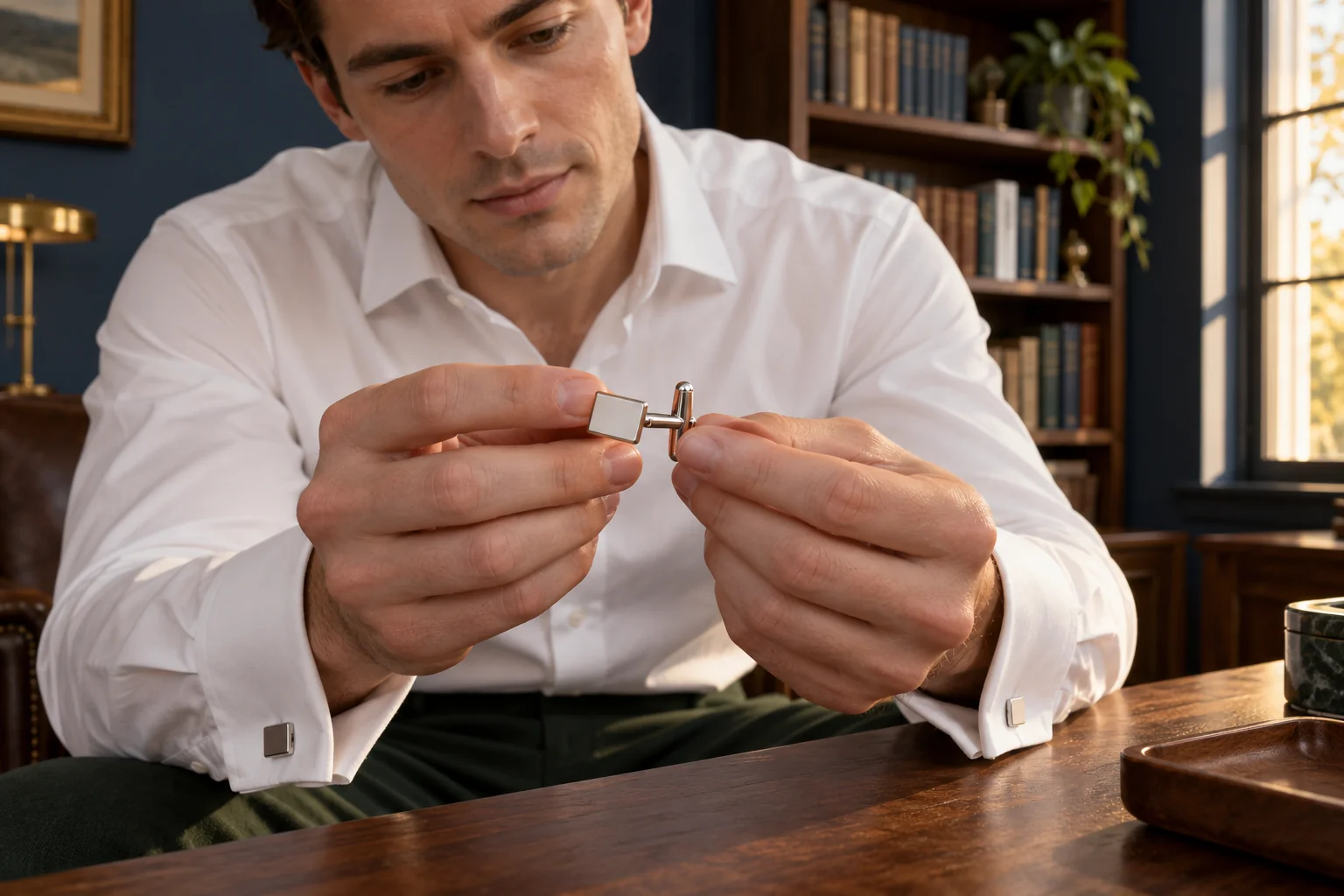
Place the pair on a clean tray or clear table. Inspect the decorative face, stem and rear fastening without putting a point against your skin. For the pivoting-bar type used here, the back can be turned into line with the stem for insertion and moved across it for fastening. Learn that movement gently with the cufflink separate from the shirt first.
The Le Mousquetaire fastening guide, in French outline preparing the sleeves, passing through the intended openings and closing the retaining mechanism. We apply only that basic sequence to an appropriate hinged design. Fixed backs, chains, knots and other mechanisms are separate cases, not objects to pry into the same configuration.
If a hinge is stuck, a surface feels rough or the pair appears incomplete, stop and check the maker's instructions or ask the retailer. Do not use pliers, an improvised lubricant or extra force as part of getting dressed. A damaged accessory is not made suitable by deciding that you must finish the outfit with it today.
Prepare a place where small parts stay visible
Give yourself a clear surface and usable light. Keep the unused cufflink in the tray while handling the first one, rather than balancing both on a narrow edge. Remove clutter that would make a dropped accessory hard to find. You do not need a special dressing station: a stable, clean part of an existing table is enough for this preparation.
Allow time for an unfamiliar fastening before you are already trying to leave. Our morning routine guide helps place small preparation tasks realistically. Practising the mechanism when the shirt is off can be more manageable than discovering its operation while your other hand is occupied by the cuff.
If you need help holding a cuff steady, ask someone you are comfortable asking. That is a practical arrangement, not a failure to learn a skill. Keep hands and fabric supported and choose a position that lets you see what you are doing. A hurried struggle at an awkward angle is not a useful standard to repeat.
Fold and align without stretching
Put on the compatible shirt and fold back the cuff according to its construction. Bring the two cuff edges together so that the corresponding openings align, rather than overlapping them as though fastening an ordinary sewn button. For the standard double cuff described here, you are bringing the matching openings in its folded layers into line.
Use your fingers to hold the fabric lightly near the openings. If the holes do not line up, release and rearrange the fold instead of pulling harder around your wrist. Check that a twisted sleeve or a folded-under edge is not creating the difficulty. The opening should be found in the fabric, not made by pushing a metal stem against it.
You do not need to make the cuff look perfectly identical to a photograph. Differences in shirt construction and cufflink shape matter. Keep the operation within the instructions for your actual items. When the arrangement remains unclear, take the cuff away from your wrist and inspect it more comfortably before trying again.
Pass the stem through the prepared openings
With the appropriate rear bar positioned for insertion, guide the stem through the aligned openings while supporting the fabric. Keep the decorative face on the outside of the cuff. Work through the existing openings gently, keeping the metal away from your skin and avoiding a hard push when the fabric resists.
If the stem stops, withdraw it and check the alignment. One layer may have moved, or the rear bar may no longer be in the insertion position. Do not solve either issue by dragging the sleeve or pressing a point towards your wrist. Repositioning the fabric and mechanism is the next useful action, not increasing force.
Stop if the link or cuff seems incompatible. A sequence that works for one hinged cufflink does not prove that a different stem length, cuff thickness or fastening should behave identically. Use the maker's instructions to resolve that question. Leave repair or alteration to a separate appropriate service instead of improvising it during this task.
Close the fastening and release the fabric
Once the stem has passed through the intended layers, move the hinged rear bar into its fastening position according to the accessory's instructions. Release your hold on the cuff and check that the fastening remains seated during an ordinary small movement. Do not pull hard on the decorative face as a test or use the closure to squeeze the cuff tighter.
Look once for an obviously trapped fold, a rear bar left in its insertion position or a cuff edge that has not been included properly. If something is wrong, open the mechanism and reset it gently. A cufflink should not require continuous pulling or pressure from your other hand to remain in the intended arrangement.
Check ordinary wrist movement
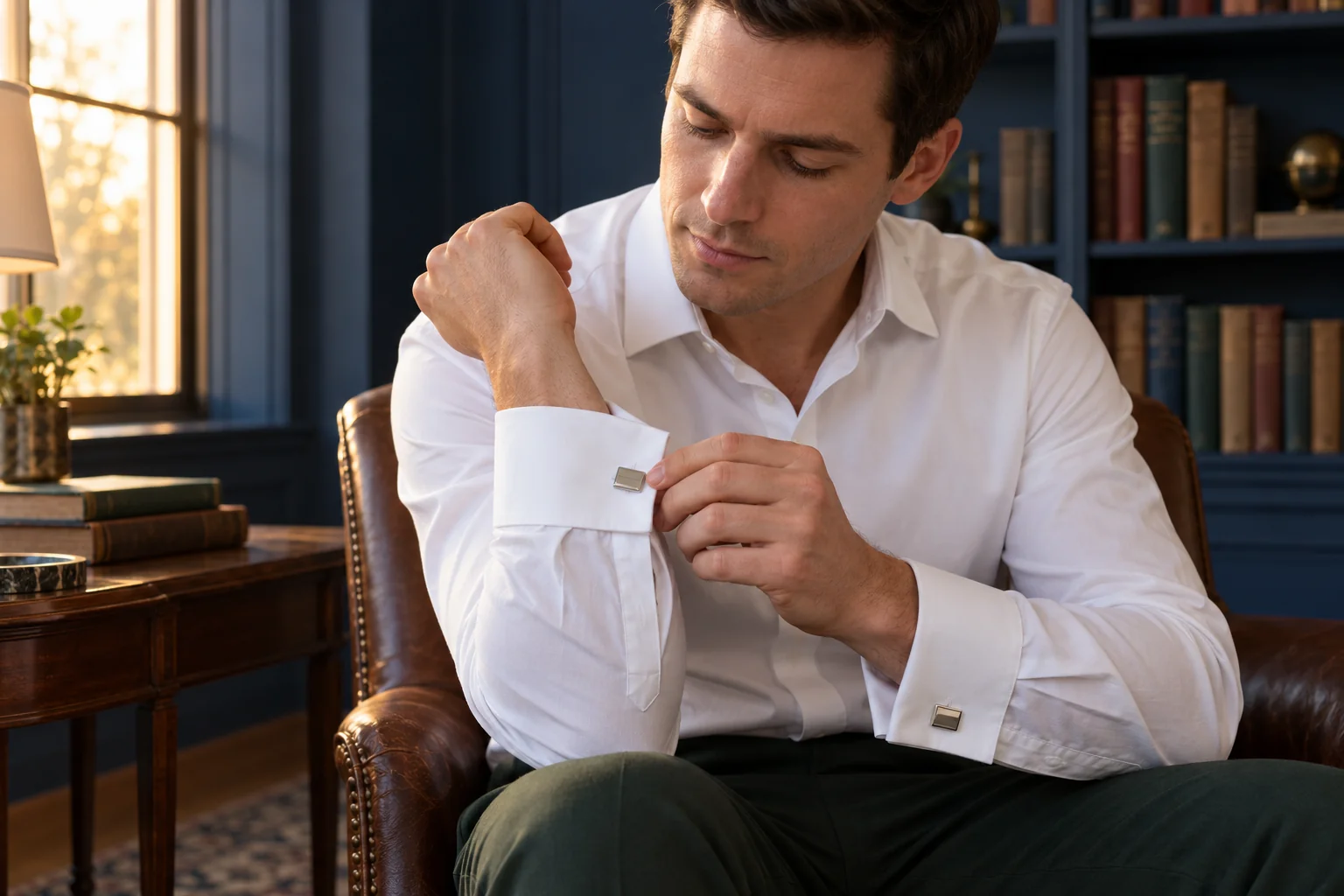
Lower your hands and move your wrist normally. Rest your hand on a table and bend your elbow as you would during the occasion. The useful question is whether the arrangement is comfortable and manageable, not whether it creates a particular silhouette in a close-up photograph. Do not use a cufflink to compensate for an unsuitable shirt cuff.
If the cuff feels restrictive, catches repeatedly or makes movement uncomfortable, undo it and reassess the compatible shirt and accessory. You do not need to persist to prove that the outfit works. A button-cuff shirt or another suitable garment is a reasonable option when the intended arrangement does not serve the day ahead.

Repeat for the other cuff without rushing
Keep the first fastening as a reference for the sequence, not a demand for perfect visual symmetry. Prepare the second cuff, align its openings and follow the same appropriate mechanism instructions. Your opposite hand may make the movement feel less familiar. Take a moment to change your position rather than twisting your wrist into an awkward angle.
After both cuffs are fastened, perform one ordinary movement check with the clothes you plan to wear. A jacket sleeve that catches on an accessory is a separate compatibility question. Our wardrobe fit audit keeps outfit decisions tied to actual movement and use, instead of turning a small accessory into a judgement about body proportions.
Give MogRise one limited preparation job
MogRise is our publisher's app. Its official product description includes personal plans, focused daily actions and Coach follow-up questions. For cufflinks, those functions can optionally help organize a task whose basic compatibility and instructions you have already checked. They do not turn an appearance result into an assessment of a metal fastening or shirt construction.
Choose one practical action that makes the task easier: find the compatible shirt, put the pair in a tray, or learn the hinge movement before the occasion. You do not need to add every possible improvement to a plan. Daily actions in an app do not mean that you should wear cufflinks or inspect your wrists every day.
Ask a question about the sequence, not a score
A useful Coach question gives a real constraint: you have an unfamiliar hinged pair, a compatible double-cuff shirt and limited preparation time. Ask how to arrange a short practice and the getting-ready sequence. Keep any suggestion within the verified instructions for the items. The app cannot guarantee that a fastening is secure or that a cuff will feel comfortable.
If the app adds decisions without making preparation easier, use the same sequence without it. A brief note about where the pair is kept or which shirt is compatible may be sufficient. This is an optional organization aid, not another device needed to prove that the outfit has improved.
Finish after a useful check
Put unused packaging and any spare accessories away. When taking the cufflinks off later, open the fastening before withdrawing the stem and support the fabric rather than dragging it through. Store the pair together in a suitable place according to its care instructions. Remembering where it belongs makes the next use easier without creating another appearance ritual.
One observation about preparation is enough to guide a next decision. If clothing checks become distressing or difficult to stop, qualified support is more useful than collecting additional scores. Our guide to tracking style without overthinking focuses on a limited practical question and leaves space for the rest of your day.
Questions about putting on cufflinks
Can I use any shirt?
No. Check the actual cuff construction and its instructions. This guide uses a folded-back double cuff intended for cufflinks. Do not cut holes or remove buttons to adapt another shirt during the task.
Does every cufflink have a turning bar?
No. Hinged bars are only one design. Chains, fixed backs, knots and other mechanisms need their own appropriate instructions. Do not force a different construction into the sequence described here.
What if the openings will not align?
Release the fabric, inspect the fold and start again gently. If compatibility remains unclear, stop and consult the relevant maker or retailer. More pressure is not a substitute for a matching shirt and accessory.
Do I need an app to learn this?
No. The compatibility check and fastening instructions stand alone. MogRise can optionally organize preparation, but cannot inspect, certify or repair the items, and a score is not needed to finish getting dressed.