

Towel drying hair as one manageable step
Towel drying hair can be a small part of getting ready rather than a long attempt to make every strand behave. After washing, you may simply want to stop water dripping onto your clothes and move on to the next appropriate part of your routine. That is a practical goal. A completely dry finish, a particular wave pattern or a photograph-ready hairstyle is a different outcome and may need a different process.
This guide covers preparing a clean soft towel, using light supported contact and deciding when the towel step is finished. It does not set a universal drying time or promise a change in hair growth, scalp health or appearance. MogRise can optionally help organize a limited task through its existing personal-plan, daily-action and Coach features. Those features do not identify a hair condition or tell you that a particular technique is medically suitable for you.
Choose the next practical need before you start
Think about what happens after washing. Perhaps you need to put on a clean shirt without wetting its collar, or you want enough time to let your hair continue drying naturally. State that need in ordinary words. It gives you something more useful to work towards than the vague instruction to make your hair look better.
Make room for the step before you are already late. Put the towel within reach on a dry surface, leave space to stand comfortably and keep your next piece of clothing away from splashes. A routine that depends on hunting for a towel while water runs down your neck is harder to carry out calmly.
If you are reviewing your morning grooming routine, give towel drying its own modest place. It need not become another elaborate task squeezed into the same few minutes as shaving, choosing clothes and finding everything you need to leave home.
Start with a towel that is ready to use
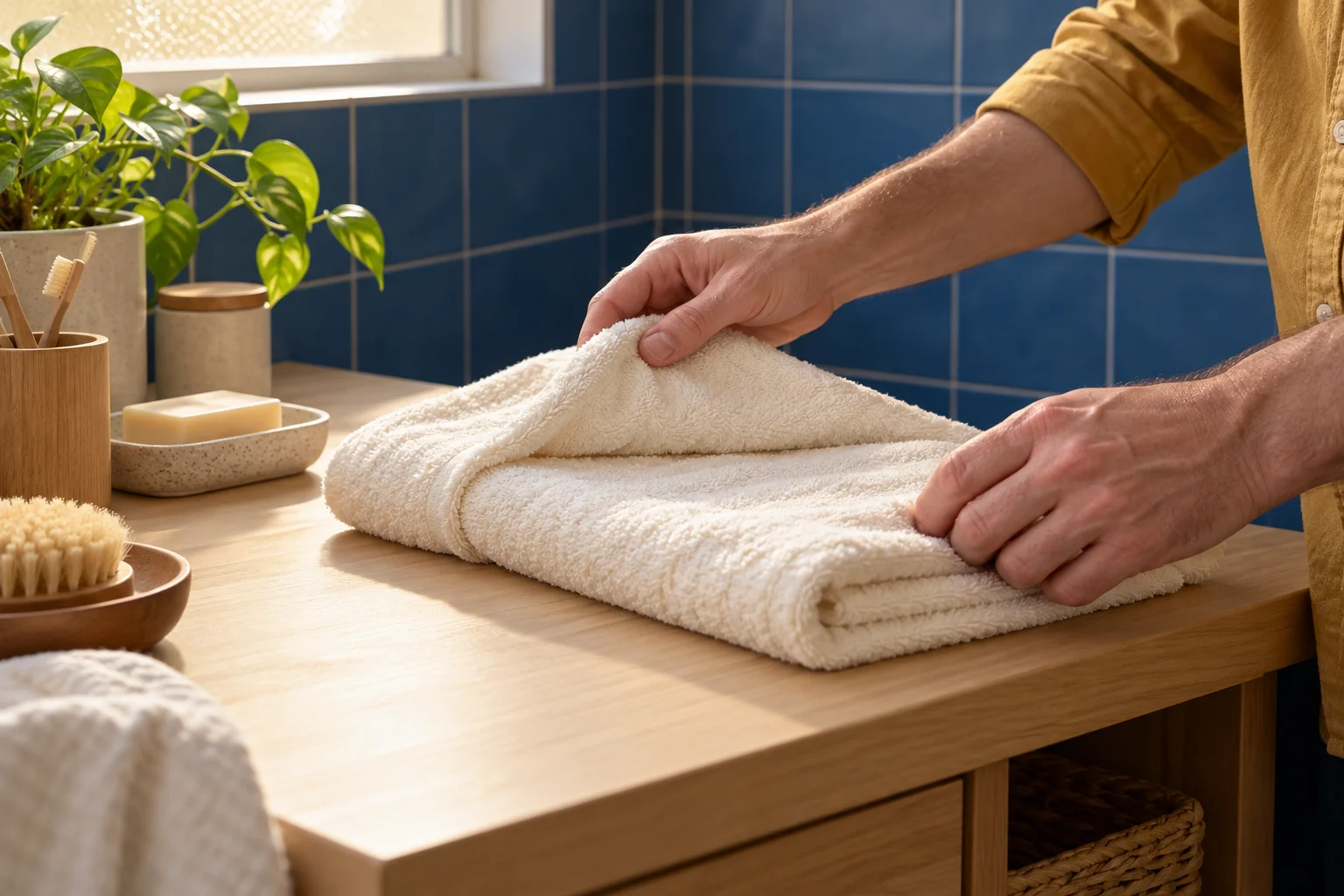
Choose a clean, dry, soft towel that is convenient to handle. You do not need to buy a specialist item just to begin this routine. Check that the cloth has a usable dry area and that it is not carrying visible residue from another task. A towel used to wipe a counter is not the one to put against your hair.
The American Academy of Dermatology's hair-styling guidance lists towel wrapping and air drying as options, and notes that handling advice for wet hair can differ with hair texture. This article stays with the towel step. It does not add a universal brushing or detangling instruction to it.
Unfold the towel enough to see what you are holding. A small clean area used carefully is more practical than a bulky bundle you have to tug into place. The illustrations show ordinary cloth contact, not a prescribed towel brand, fibre ranking or guarantee about the finished hairstyle.

Bring the towel to the hair with light contact
Stand or sit in a stable position and support the towel with relaxed hands. Bring a usable part of the cloth to one accessible area of the hair. Hold it against the hair lightly, then release and reposition. Avoid treating this as a scrubbing job or dragging a heavy towel repeatedly across your head.
You do not need to twist the cloth tightly, pull on the hair or make a firm head wrap to keep it in place. If the arrangement feels awkward, lower the towel and begin with a smaller section. The practical aim is controlled contact with the cloth, not increasing force until the routine feels more effective.
Use the same calm approach around the sides and any reachable lengths. Keep the cloth clear of your eyes and face when it makes the task easier. If a movement hurts or the scalp feels sore, stop rather than trying to work through it. A routine should be comfortable enough to interrupt and adjust.

Change the cloth section before adding effort
As part of the towel becomes wet, open or refold it to find another usable section. This is a change in the tool you are using, not a reason to press harder. Holding a saturated bundle against the same spot again and again can turn a simple step into unnecessary repetition.
Keep the towel loose while changing its position. You can rest it on a clean dry counter briefly rather than pulling at it behind your head. Do not wring it while it is wrapped around your hair. If the whole towel is no longer useful, decide whether a clean dry one is actually needed for the remaining task or whether the towel stage is already complete.
Use an endpoint you can observe
Look for the practical result you wanted, such as no longer having water drip onto your collar while you stand normally. That is different from testing every section until it feels completely dry. Some moisture can remain when the towel step ends, depending on what comes next in your own routine.
Do not borrow an exact number of minutes from a different person's hair and turn it into a rule. Length, texture, the starting amount of water and the towel arrangement can all change the experience. A fixed countdown is not evidence that the task has succeeded or failed.
Pause once, with the towel lowered, and decide whether the original need is met. If it is, finish this stage. If it is not, choose one small practical adjustment, such as changing to a dry cloth section. Avoid turning the decision into repeated mirror inspection or a search for an ideal hair texture.
Separate towel drying from styling decisions
A towel is not a substitute for reading the directions of a styling product or considering your usual hair-care advice. If your next step involves a product, check the required hair condition on its own instructions. Do not assume that towel-dried means the same amount of moisture for every product and every head of hair.
Our guide to using hair wax treats application as a separate task. Drying more aggressively will not settle an unclear product instruction. You can leave a styling choice for another occasion instead of adding several new steps because you have already started getting ready.
Put the towel away and leave this step finished
Once the practical endpoint is reached, lower the towel and put it in an appropriate place for drying or laundering according to its care instructions. Avoid leaving it in a damp bundle where you will later mistake it for the prepared clean towel. Make the next use easy to organize.
The finishing action matters because it makes the boundary visible. You have not abandoned the routine because your hair remains naturally damp. You have completed the towel part and allowed the next suitable stage to happen separately.
If concerns about discomfort, unusual shedding or persistent scalp symptoms are driving repeated drying experiments, ask a qualified clinician for advice. Towel technique is not a diagnosis or treatment. Do not keep changing pressure or frequency in an attempt to solve a medical concern through this small grooming task.
Give MogRise a narrow planning role
MogRise is our publisher's app. Its official product description includes personal plans, focused daily actions and follow-up questions to the Coach. For this routine, use that scope to organize a decision you have already checked against suitable advice, not to ask for a hair-health verdict from an appearance result.
Explain a practical constraint, such as having a short getting-ready window or wanting to replace rough rubbing with a calmer sequence. A useful Coach question is how to arrange the preparation, one gentle towel step and a clear finish around that constraint. Check any care suggestion against an authoritative source and your own professional advice where relevant.
From the plan, choose one manageable action: prepare the towel before washing, use light contact, or put it away after the chosen endpoint. You do not need to change all three at once. The existence of daily actions in an app does not mean your hair must be washed or assessed every day.
Review the action without collecting appearance scores
After the routine, ask a practical question once: was the towel ready, did the step feel manageable, and did you stop when the original need was met? That tells you more about the usefulness of the plan than another photograph or a number attached to your appearance.
MogRise does not need to be the centre of the task. If app use creates more checking or decision-making, carry out the same bounded routine without it. A plain written note about preparation or timing is enough if you want to remember a useful adjustment.
There is no need to create a before-and-after comparison or promise yourself a visible transformation after several days. The outcome being organized here is a usable grooming action, not proof that your hair or your face has become better.
Three situations and a realistic next step
If you have short hair and only want to stop drips, prepare a small usable towel area and stop when that limited need is met. Do not add a long wrapping stage merely because another routine shows one. If longer hair makes the cloth awkward, work with a manageable loose section and seek tailored advice if you are unsure about handling it comfortably.
If you are in a hurry, postpone optional styling experiments rather than trying to compensate by rubbing harder. If there is not enough time for the next stage you had planned, change the plan. A realistic sequence is more useful than forcing a complete finish into an unsuitable time window.
Keep the routine from turning into repeated checking
Choose only the observation that will help the next practical decision. You might notice that the towel was out of reach or that clothes were placed too close to splashes. Fix that small setup issue next time instead of repeatedly inspecting the same hair in different lighting.
Our guide to tracking style without overthinking explains how to keep observations useful and limited. If appearance concerns or checking become distressing or difficult to stop, qualified support is more helpful than adding another score or inspection ritual.
The task can end with an ordinary statement: the towel was prepared, the hair was handled gently and the towel stage is finished. That is enough information to continue with the rest of your day.
Questions about a gentle towel step
Must my hair be completely dry afterwards?
No universal endpoint applies to every routine. This guide uses a practical towel-stage goal and keeps the next suitable drying or styling step separate. Follow any relevant product or professional instructions.
Do I need a particular towel material?
A clean, dry, soft towel you can handle comfortably is a practical starting point. This article does not rank fibres or promise that buying a new towel will change your hair.
Should I brush while using the towel?
Brushing is a separate question, and wet-hair handling advice varies with texture. Do not add a universal brushing step to this routine. Use advice appropriate to your own hair.
Is an app required to know when to finish?
No. The practical need you chose and one limited check provide a stopping point. MogRise can optionally organize the sequence; it cannot diagnose a condition or guarantee a result.