
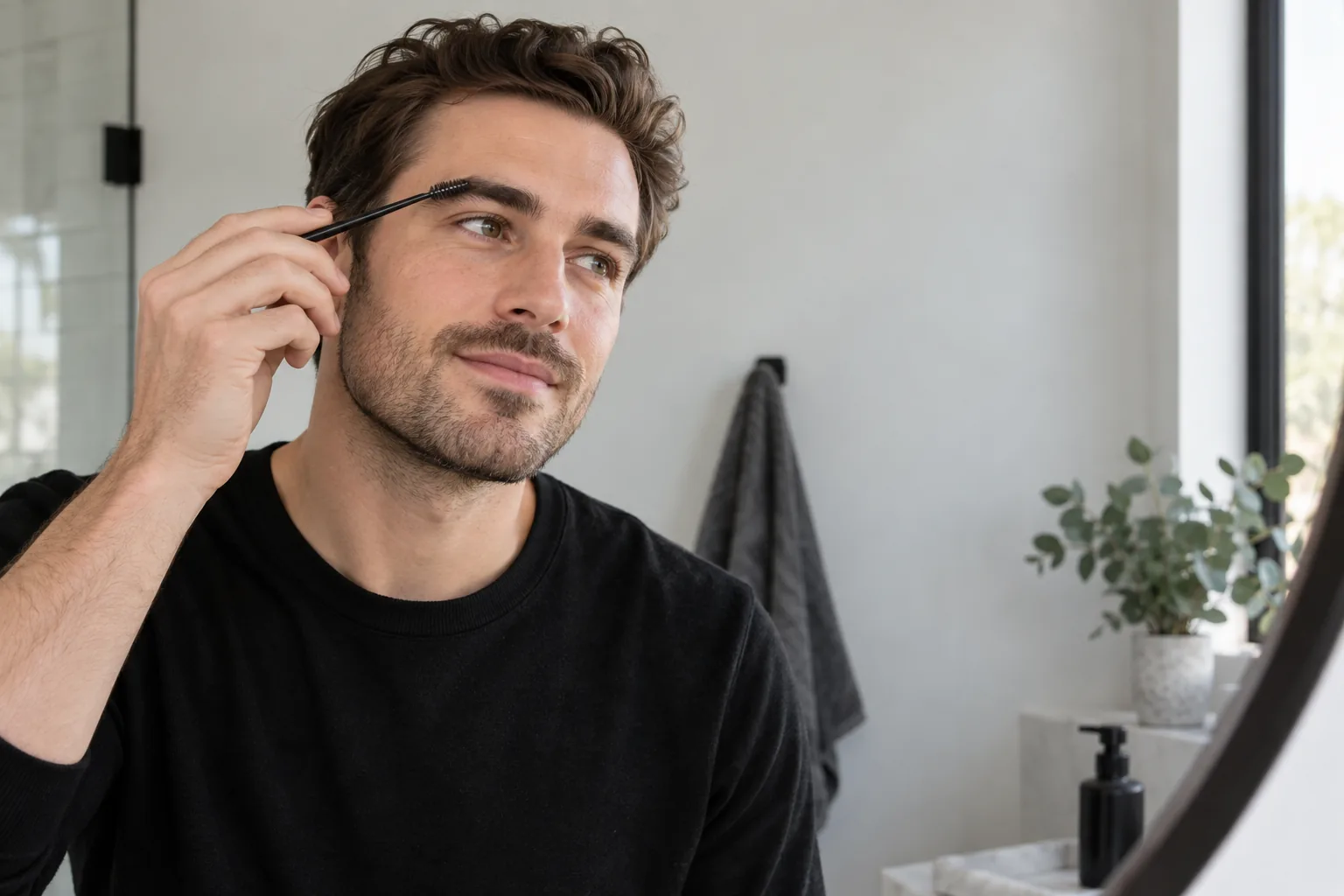
Men’s eyebrow grooming starts with a question, not a template
Men’s eyebrow grooming starts with the frame around your eyes, but there is no correct thickness, arch or distance that every man should copy. A heavy brow can be part of your natural appearance; a small gap between the brows can be a deliberate choice. The useful question is narrower: are long hairs obscuring the outline, are a few strays distracting you, or are you simply reacting to an unflattering close-up? Each question suggests a different action. This is why our broader eye-area looksmaxxing guide treats brow grooming as one part of the whole frame, alongside glasses, hair and lighting.
Start at a normal mirror distance in ordinary daylight. First look at your whole face, then at the brows. Notice where each brow begins, where the main body is densest and whether its tail is visible. These are observations, not a facial score. Avoid drawing an imaginary perfect line over your face or trying to force two naturally different brows into identical shapes. The goal of this article is a controlled, reversible grooming decision that still looks like you.
Decide whether to brush, trim or remove hair
These three actions solve different problems. Brushing changes the direction of existing hairs and is immediately reversible. Trimming shortens selected long hairs while keeping the brow body intact; it requires a little patience as hair grows back. Removing a hair changes the boundary itself. Because those steps have different consequences, do them in that order. A spoolie alone may reveal that the brow only needed arranging. A tiny trim may settle an unruly end without any plucking.
Before touching a tool, state a specific goal in one sentence: “I want the long tips above my right brow to sit within the natural outline.” Compare that with “I want better brows,” which offers no stopping point. Work on one concern at a time and check your face again from the distance at which other people normally see you. If the change only becomes visible under a magnifying mirror, it may not be worth making. There is no obligation to groom your brows at all.
Assemble a small, clean kit
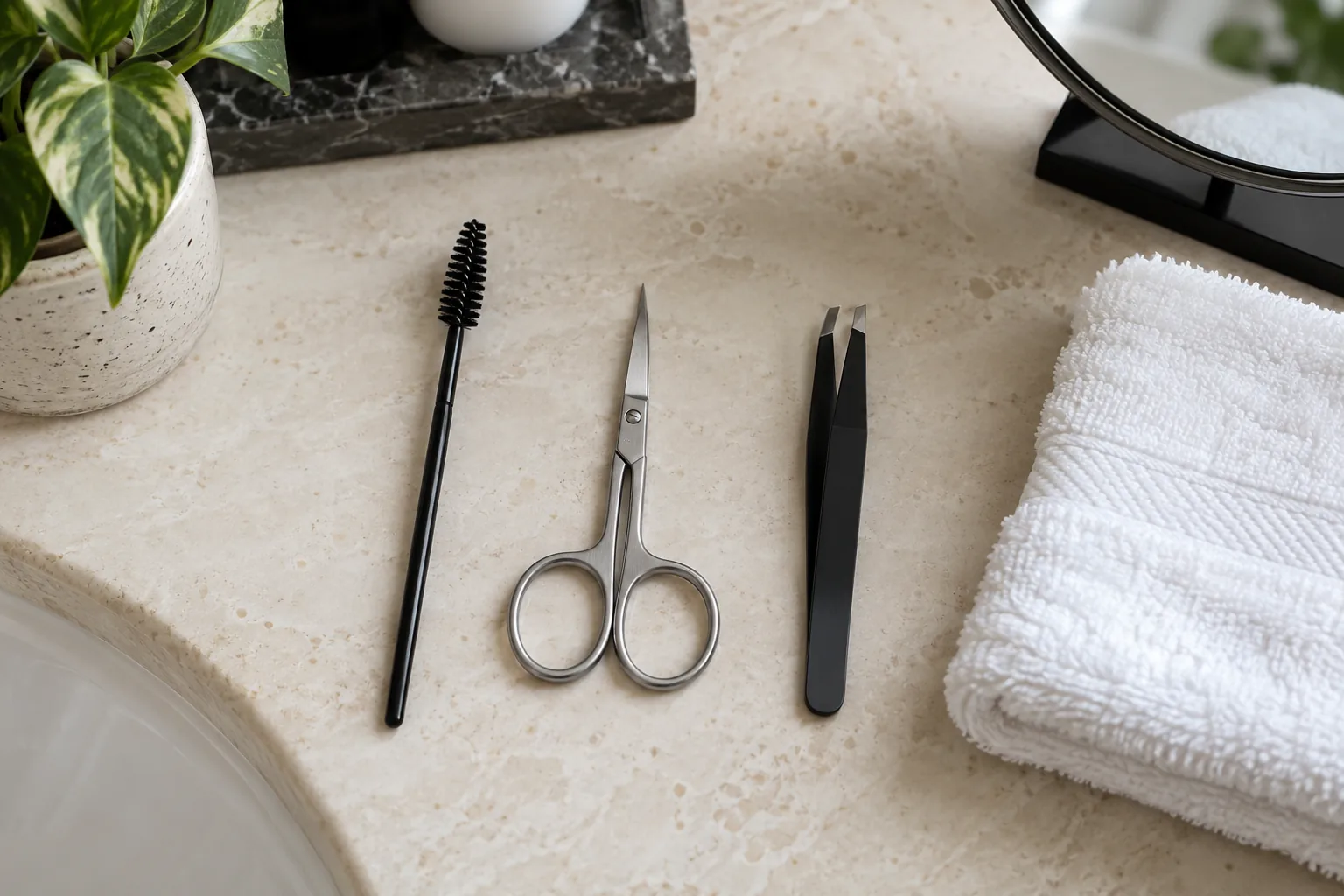
A clean spoolie or small brow brush, a little pair of brow scissors, a mirror and good light are enough for a first pass. Tweezers are optional. Put the tools on a clear surface, wash your hands and make sure the scissors are easy to control. A fine comb helps you see which hairs actually extend beyond the current outline. A large beard trimmer or an unguarded clipper can remove a broad strip before you realize it, so it is a poor first tool for a tiny correction.
The Philips guide to brow shaping for men describes brushing hairs up before identifying tips that need trimming. We use that as a technique reference, not a product recommendation. You do not need a particular brand, kit or device. If your scissors feel too large or your lighting makes the edge hard to see, stop and wait for better conditions rather than improvising near your eye.
How to trim men’s eyebrows without flattening them
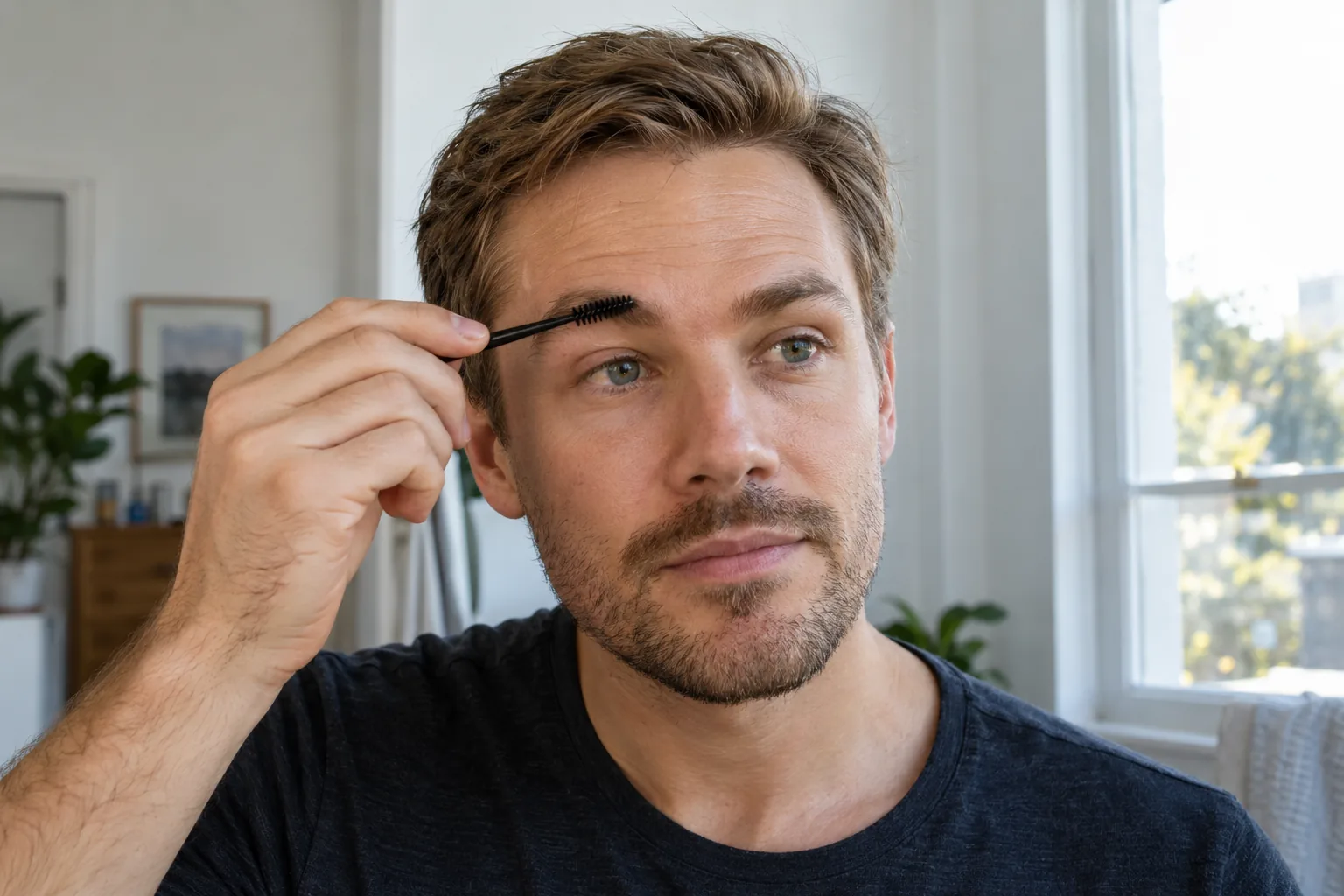
Brush the inner and middle sections gently upward, then follow the natural direction toward the outer tail. Look for individual tips that project noticeably beyond the usual brow outline. Hold the skin relaxed; stretching it changes where the hairs will sit afterward. With small, controlled scissors, shorten only those visible tips, one at a time. Put the brush down and let the hair fall back into place after every few snips. This pause is the part that prevents a narrow brow from turning into an accidental uniform crop.
Do not cut an entire line along the top of the brush. Thick brows often contain hairs of different lengths that overlap to create fullness. Cutting them all to one height can expose gaps once they lie flat. Avoid cutting at the roots or trying to build a new arch with scissors. If you cannot distinguish a stray tip from the body of the brow, leave it. The result should be ordinary brows that sit a little more neatly, not a sharp outline that announces the procedure.
The center gap and the temptation to over-pluck
Some men like the hairs between their brows; others want a clearer separation. Neither preference is a rule about attractiveness. If you choose to remove isolated hairs in the center, mark mentally where the dense body of each brow begins and stay within the actual gap. Remove one clearly separate hair, step back, then decide whether anything else is needed. Do not use a finger-width formula: noses and brow spacing differ. A single ordinary mirror gives a more useful view than switching repeatedly between magnifying mirrors and phone selfies.
The American Academy of Dermatology’s hair-removal overview distinguishes methods and notes that waxing can irritate or injure skin; it also describes threading as an option for precise eyebrow work. That information is a reason to avoid casual experimentation with hot wax or depilatory chemicals near your eyes. If the skin is irritated, broken or affected by a treatment you use, postpone hair removal and ask a qualified professional about a suitable method. This is grooming guidance, not a medical treatment plan.

Read the result in context
After a trim, walk away for a few minutes and return in ordinary light. Look at your eyes, forehead, hairstyle and expression together. A fringe can hide part of the brows; glasses may draw a new line above them; harsh overhead light can exaggerate a shadow. If you change several of those at once, you cannot tell which one changed the impression. The same principle applies to photos: a closer phone camera can make the brow area look unfamiliar without any grooming change.
If you want a record, take one relaxed photo in the same light and at the same distance as an earlier reference, then leave it alone. Do not repeatedly zoom into individual hairs or chase symmetry frame by frame. The point of a comparison is to answer the original question: did the long tips settle, and does the brow still feel like yours? If it does, stop. If the result feels too tidy, put the tools away and allow normal growth rather than making another correction immediately.
Common mistakes that make a natural brow harder to keep
The most frequent mistake is changing the shape before understanding the hair direction. Cutting every strand that rises when brushed upward makes a dense brow look patchy when released. Plucking along the upper edge can also move a recognizable natural boundary. Broad wax strips, close shaving and deliberate eyebrow slits are style choices with their own upkeep; they are not required steps in a basic looksmaxxing routine. A mark made with a cosmetic pencil can be tested and washed off before any permanent-looking choice.
Another mistake is trying to solve a skin concern with more hair removal. Redness, bumps or tenderness around the brows call for gentler handling, not a sharper line. Our skin-care foundation guide explains why keeping a simple routine and watching how your skin responds is more useful than stacking new treatments. If you notice persistent irritation, sudden loss of eyebrow hair or another symptom that worries you, talk with a qualified clinician rather than diagnosing it from a photograph or an AI score.
When a barber or brow professional is the better choice
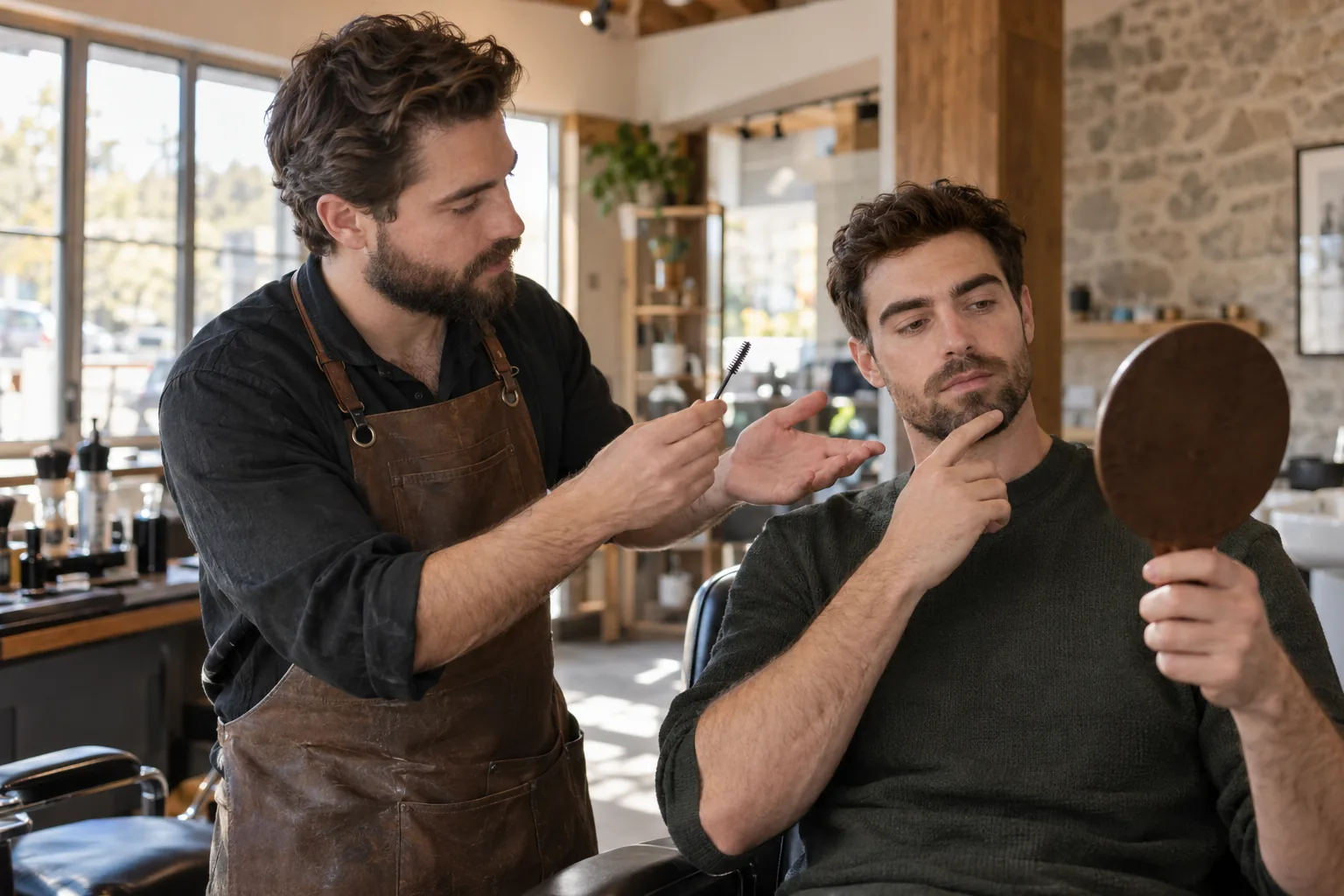
A professional can be helpful if you want someone else to perform a small clean-up, if your hands are unsteady, or if you are unsure where the natural boundary lies. The brief should be specific: “Please keep the thickness and shape. Brush the brows into place and shorten only the few longest tips. Ask me before removing hairs.” Bring an ordinary photo of how you usually wear your hair if a fringe affects the brow frame. This makes the appointment about your preference rather than a default salon template.
Before leaving, check the result from conversational distance, not only in a bright magnifying mirror. Ask what was trimmed or removed and how to maintain that exact level, if you want to. You can also say that you prefer no plucking. Our barber briefing guide applies the same principle to the haircut around your face: define what to keep, what to change and how much upkeep you actually accept. A good brief protects your choices across appointments.
Build a calm maintenance rule
An eyebrow routine does not need a daily inspection. After the first tidy-up, notice in ordinary life whether a particular long hair becomes distracting again. If it does, repeat the same minimal brush-and-trim process; if it does not, leave it. Keep the tools clean and avoid using a large clipper because it is already in your hand for the beard. A preference for completely untouched brows is just as valid as a preference for a slightly neater frame.
Think of maintenance as preserving a decision, not finding a new flaw. If a change makes you feel compelled to check every mirror or seek another numeric rating, step back from the process. A score cannot tell you whether your grooming suits your life. Choose a sensible limit for the task, then return your attention to something else. If appearance thoughts cause ongoing distress or interfere with your day, a qualified mental-health professional can help more than another photo comparison.
Frequently asked questions
Should men pluck their eyebrows?
Only if they personally want to remove a specific isolated hair. Brushing and selective trimming may be enough. No brow thickness or center gap is universally correct. If removal causes irritation or you are unsure what to do near the eye, leave it and ask a qualified professional.
Is a brow trimmer better than scissors?
Neither is automatically better. Small scissors let you shorten individual long tips; a guarded brow trimmer can be convenient when used as designed. Avoid an unguarded beard clipper for your first attempt. The safest choice is the tool you can control with good light and an unhurried hand.
How often should I groom my brows?
There is no fixed schedule. Wait until the same specific issue is visible again in normal light. That may take different amounts of time for different people and different hairs. Daily checking is unnecessary; the point is to keep a routine that fits your life.
Can brow grooming change my eye shape?
It can change the visible frame around the eyes, not the underlying anatomy. Hairstyle, glasses, expression and lighting influence the same impression. Treat any “hunter eyes” label or AI face score as subjective presentation language, not a diagnosis or a guarantee that grooming will create a different eye structure.