

- Treat the label as a rough description, not a prescription.
- Compare silhouette and upkeep before choosing a haircut name.
- Bring a specific question to your barber.
Face shape is a shorthand description of the outline you see. In looksmaxxing, its value is the next question it helps you ask: how should hair width, forehead exposure or beard length relate to that outline? Start with observable proportions and use the label only when it clarifies the discussion.
Connect the shape label to a visible dimension
If you describe a face as long, round, angular or tapered, identify which visible dimension prompted that description. The upper-face frame, cheek width and lower-face contour may suggest different directions. Keep hair and facial hair in the observation because they contribute to the silhouette you are judging.
Choose a comparison that follows from the dimension. To assess added height, vary top volume. To explore the lower outline, compare one beard contour. Avoid stacking several rules from different face-shape charts. A clear, controlled comparison is easier to explain than a label that keeps changing between photos.
Describe what you see before naming it
Start with one clear, eye-level front photo. Keep the camera far enough away that you are not making a close selfie, and move loose hair away from the edges of your face. Notice overall length, width around the cheeks, the forehead and the outline around the chin. You do not need a calculator or a perfect category.
Write a neutral observation such as “I prefer less volume at the sides” or “I want the fringe to feel lighter.” That gives a barber something to work with. Trying to prove that you are exactly oval, square or diamond often adds certainty that the photograph does not justify.
Compare the outline, not just the haircut name
Two cuts with the same name can have very different proportions. Compare the height on top, weight around the temples, length near the ears and how much forehead is visible. Change one of those variables in your reference selection so that you can explain why one version appeals to you.
Take a front and side view of each idea into account. A style can look good from the front but demand a shape at the back that you do not want to maintain. A useful shortlist includes a reason for each image, rather than ten attractive strangers with unrelated hair.
- Reference A: the side profile I like.
- Reference B: the amount of texture I want.
- Reference C: the shortest length I feel comfortable with.
Let your real hair set the constraints
Density, curl, growth direction and the length you already have affect what a barber can produce. Ask what the proposed shape would look like without professional styling. Ask how it grows out, and which part would need attention first.
If a reference requires daily heat styling and you prefer to leave with damp hair, that is a mismatch worth identifying before the cut. You can still borrow its general shape while choosing a version that fits your morning. A more dramatic change can be staged across appointments instead of treated as a single leap.
Turn the comparison into a clear brief
Use this sentence: “I like the outline of this reference, but I want to keep this much length and spend about this long styling it.” Add one feature you want to preserve and one you want to change. The consultation becomes a discussion about practical choices.
MogRise can help you review your photos and explore a hairstyle direction. Treat a generated preview as a visual question for your barber, whose assessment of your real hair should shape the final cut. Your preferred style does not need to win a face-shape formula to be worth trying.
Measure the effect of the haircut, not just the shape label
A face-shape label compresses several dimensions into one word. For a haircut decision, separate the apparent forehead width, cheek width, jaw width and overall length. Then look at what the hair adds outside that outline. A short-sided style with substantial crown height creates a different frame from a lower crown with more temple coverage, even on the same face.
Write the effect you want before naming a cut: more upper-face openness, less vertical emphasis or a cleaner connection between the hair and beard. You can then compare references that serve that effect. This keeps looksmaxxing hair decisions tied to facial harmony instead of treating a category like oval or square as an instruction to copy one universal hairstyle.
Compare the front, side and temple zone
The front view shows crown height and apparent side width. A side view shows how the fringe, forehead and back of the haircut form the profile. The temple zone connects the upper frame to the cheeks and beard. A style can look controlled from the front but carry more weight behind the ears than you intended, so use more than one view.
Ask for references that show these transitions. If you only save a dramatic front portrait, the barber has to infer the sides and back. Note whether the style is tucked, wet, brushed back or held with product. Those details explain why the silhouette looks a certain way and whether you can recreate an everyday version with your texture and routine.
Turn a shape description into two clear options
Choose two options that differ in one major dimension. For a longer-looking face, you might compare lower crown height with the same side length. For a broad upper frame, you might compare temple coverage while keeping the fringe similar. You are testing a preference, not correcting a face-shape category.
Keep both options realistic for your current hair. An AI image or reference can help explain the direction, but it may assume more density, a different hairline or a finish you do not want to maintain. Ask the barber what must be adapted. A useful shortlist has enough contrast to teach you something and enough continuity to make the difference understandable.
| Variable | What to inspect |
|---|---|
| Crown height | How much vertical emphasis appears above the face? |
| Temple width | How do the sides connect to cheek width and beard coverage? |
| Fringe | How much forehead is exposed, and where does the boundary fall? |
| Finish | Does the preferred shape depend on volume or texture created by styling? |
Example: replacing a haircut name with a facial goal
Instead of asking for ‘the best cut for a long face,’ prepare this brief: ‘I want less height at the crown, some movement through the front and sides that stay controlled without becoming extremely tight.’ Add a front and side reference and explain how much time you normally style. The brief describes a visible outcome rather than relying on a label.
After the appointment, photograph the everyday finish and record whether the upper frame feels closer to your preference. Notice the grow-out at the temples and how the fringe behaves after washing. Keep the useful parts of the brief and change one detail for the next visit. Your face-shape analysis has then produced a repeatable haircut decision rather than an endless search for a new category.
See what
one variable changes.
Explore three framing choices in natural-color portrait pairs. Learn which detail to look for in your own comparison.
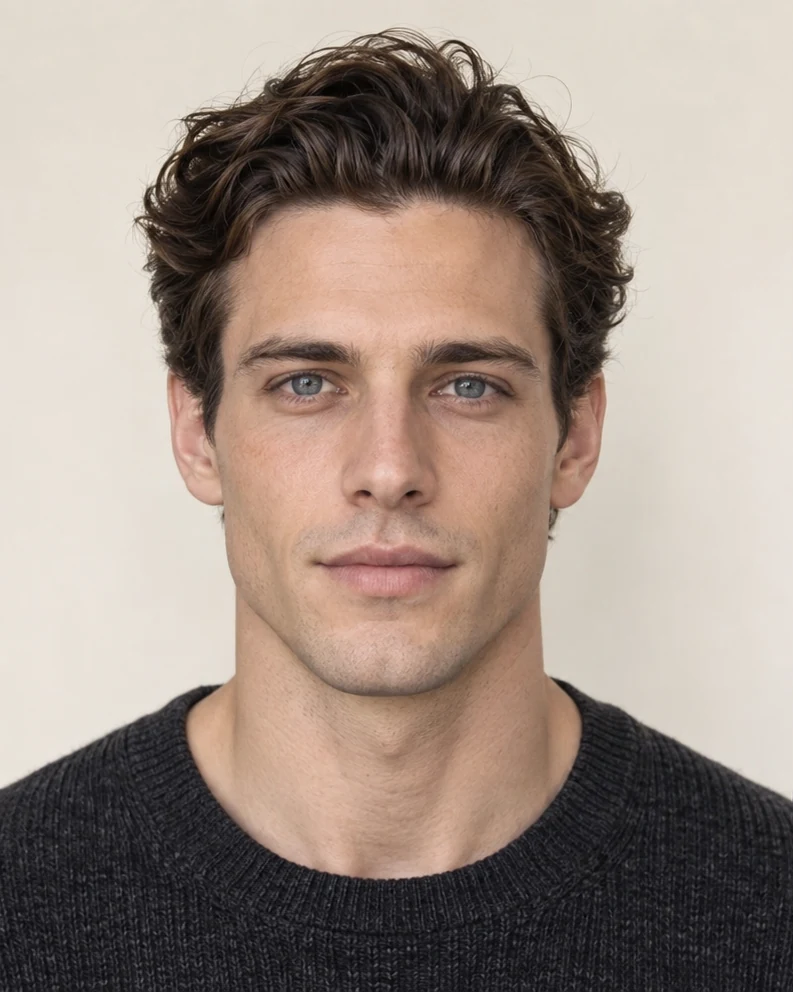

AI-generated editorial portraits · Styling examples, not transformation results
More forehead. A different facial frame.
A fringe covers part of the forehead and introduces a new edge above the brows. Moving it away reveals more of the upper face. Compare the amount of exposure before changing top height or side volume as well.
- Look for
- Where does the hair end relative to the brow frame?
- Your comparison
- Compare your usual fringe with it gently moved aside. Keep expression, beard and camera position unchanged.
Leave with a direction, not a rigid hairstyle rule.
Different photos suggest different face-shape labels, and every list recommends a different haircut.
Set the label aside and describe the outline you prefer: less width at the sides, a softer front or more visible forehead. Take that preference to a barber along with your hair texture and styling limits. Now there is a concrete idea to adapt.
Translate a shape label into a haircut question
Use the prompts to turn this guide into your own next step. The examples are suggestions; write what fits your situation.
Judge the cut after styling it yourself. The useful result is a shape you enjoy and can maintain.
Add a note to any prompt to continue. Your notes stay on this page. Download a text file before leaving.
A few useful clarifications.
01What if my face fits more than one shape category?
That is a reason to use visible dimensions instead of forcing a label. Describe width, length and the areas you want the haircut to emphasize. A mixed shape can still support a very clear framing brief.
02Is a fade always best for a stronger-looking face?
No. The effect depends on the contrast, side height, remaining weight and your overall proportions. Compare how tight sides change the relationship between crown height, cheek width and the lower face.
03Can a hairstyle change my apparent facial proportions?
It changes the visible frame around the face, including forehead exposure, side width and crown height. Evaluate that aesthetic effect with comparable views and distinguish it from the underlying facial landmarks.
Where your next question leads.

Facial harmony: read the relationships between your features.
Understand facial thirds, midface, symmetry and profile balance. Learn what a face analysis can show and how to use it in looksmaxxing.

Hair for looksmaxxing: build your facial-framing brief.
Choose a haircut around forehead exposure, temple width and facial balance. Turn your looksmaxxing goal into a precise barber brief.
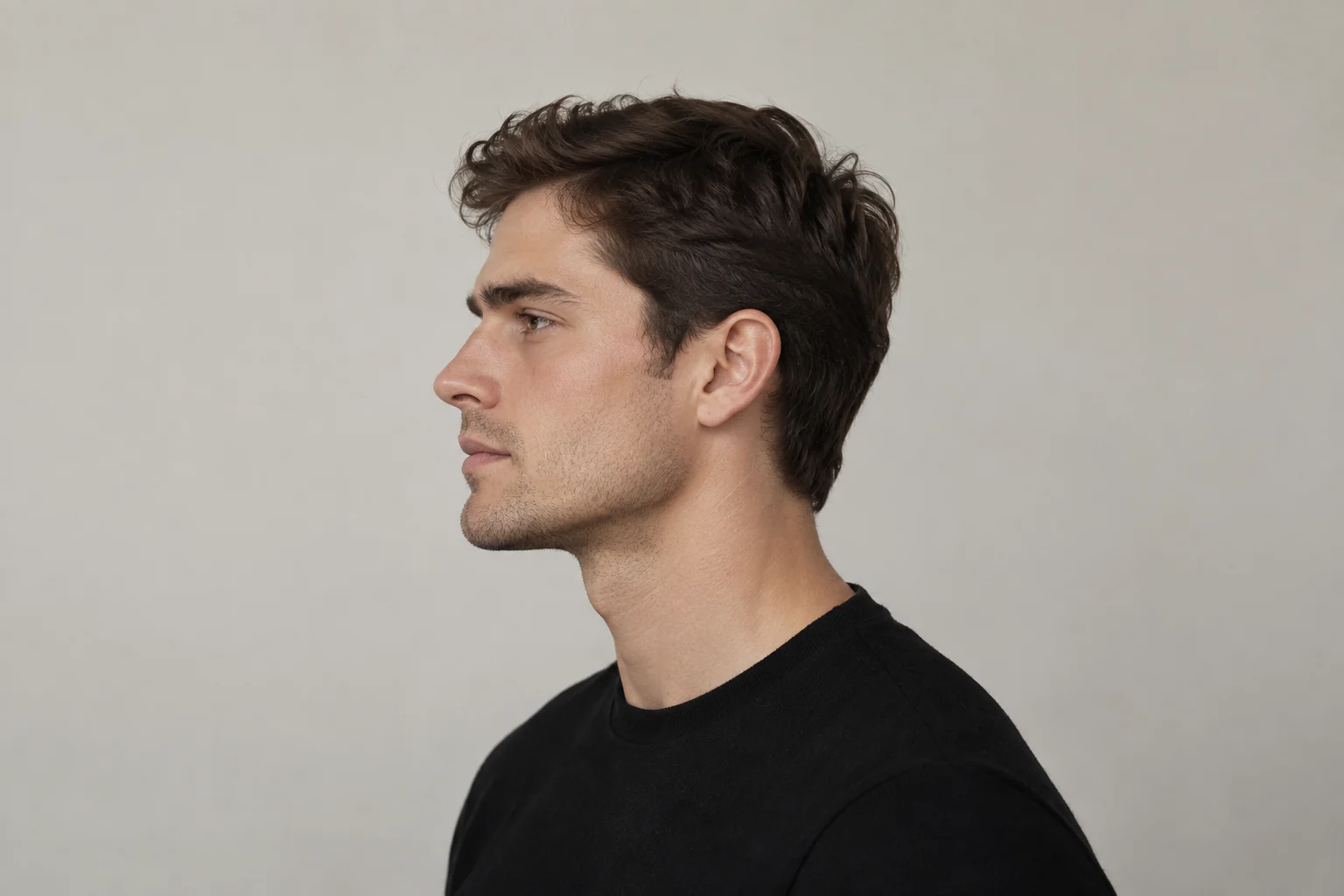
Jawline definition: separate structure, framing and the photo.
Understand jawline definition, chin and profile balance, beard framing and mewing claims before choosing your next looksmaxxing step.