
FACIAL HARMONY · 9 MIN READ
Facial harmony: read the relationships between your features.
Understand facial thirds, midface, symmetry and profile balance. Learn what a face analysis can show and how to use it in looksmaxxing.
Understand facial thirds, midface, symmetry and profile balance. Connect the proportions you notice to a useful looksmaxxing decision.
 PROPORTIONS / SYMMETRY / PROFILE
Harmony gives you a way to read relationships across the face. Look at upper, middle and lower facial height, width around the cheeks and jaw, and the connection between the nose, lips and chin in profile. Use that map to choose a framing experiment instead of treating every feature as an isolated score.
Use these pairs to turn face-analysis terminology into a question you can investigate.
| The question | AThe isolated observation | BThe relationship to check |
|---|---|---|
| Forehead | The upper face looks long. | How much forehead is exposed, and how does the hair silhouette affect apparent height? |
| Lower third | The chin area looks heavy. | How do beard length, jaw width and the upper-face outline work together? |
| Symmetry | One side looks different. | Does the difference persist in a neutral pose with even light and no head rotation? |
Use the relationship to select a test. A label alone is not yet an action.
Explore three framing choices in natural-color portrait pairs. Learn which detail to look for in your own comparison.
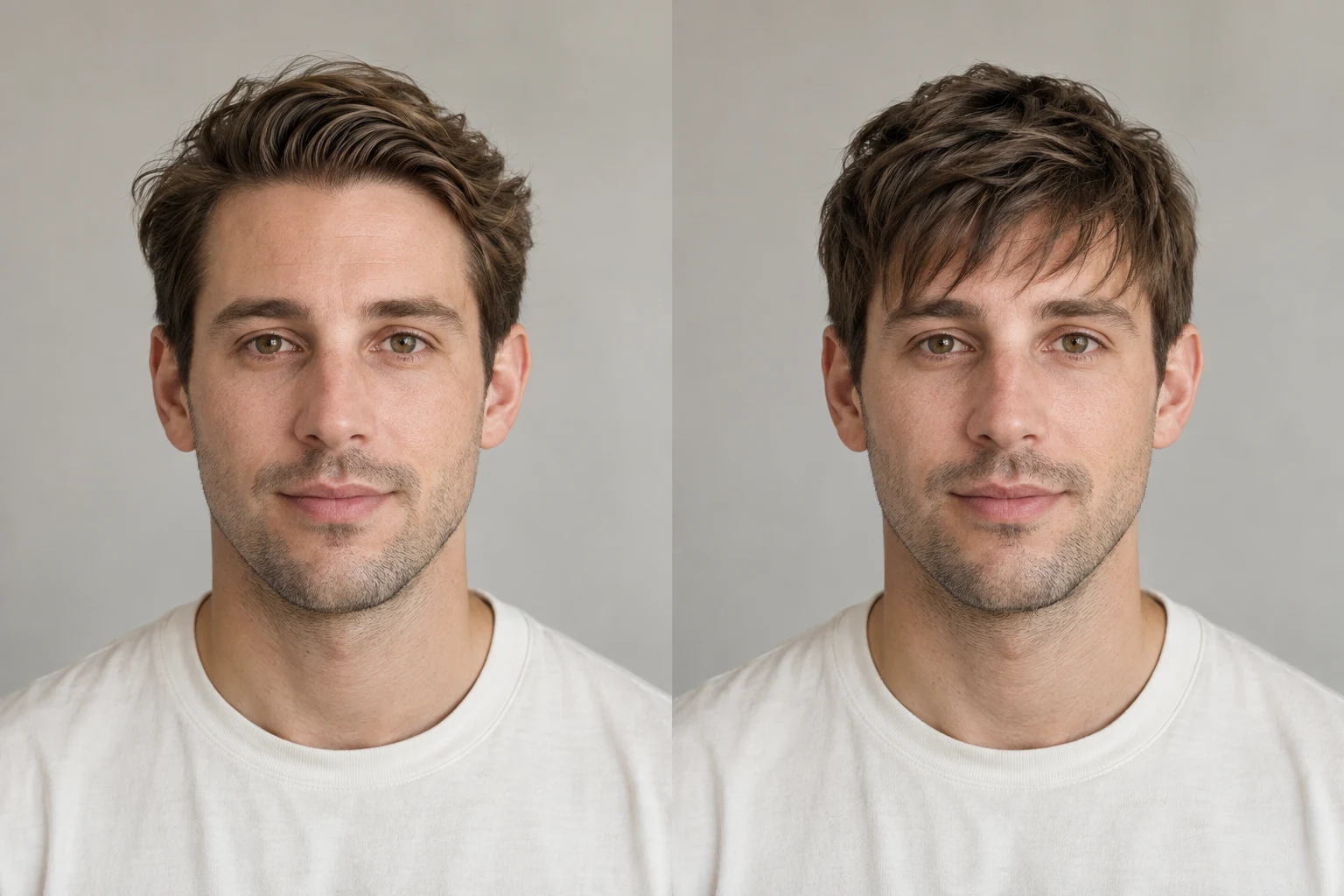
AI-generated editorial portraits · Styling examples, not transformation results
A fringe covers part of the forehead and introduces a new edge above the brows. Moving it away reveals more of the upper face. Compare the amount of exposure before changing top height or side volume as well.
Use a neutral front reference. Look at the visible forehead, cheek and jaw widths, then the apparent facial height. Describe the relationship that catches your attention. Keep hair volume and beard length in the observation because they contribute to the visible outline.
Use the hairline, brow region, base of the nose and chin as approximate vertical reference points. Then move to a true side view. A frontal proportion cannot explain the entire nose–lip–chin relationship, and unclear landmarks should remain marked as uncertain.
Test fringe placement, side volume or beard length individually. Keep the reference conditions stable. Compare the whole portrait at the same size and write which relationship changed visually. The experiment concerns framing, not a claim that your bones moved.
Read the whole outline first, the relationships between regions second and small landmarks third. The outline includes the frame created by hair and beard. Regional relationships include forehead exposure, cheek width and the lower-face silhouette. Landmarks can help describe particular proportions, but they should remain connected to the unmarked face.
This order prevents a small measurement from becoming the entire explanation of the portrait. If your preferred effect is less vertical emphasis, crown height and beard length may be useful framing variables to compare. If you like stronger cheekbone visibility, look at the surrounding hair and beard boundaries. The desired emphasis comes before a target number.
The front view and profile answer different questions. Width balance is easiest to discuss in a clear front view; the profile adds the relationship between the forehead, nose, lips and chin. A hairstyle or beard preference should be checked in both when it affects those outlines. An option that feels balanced straight on may add more length in profile than you want.
Write a sentence for each view, then connect them. For instance, a shorter chin trim may reduce added lower-frame length in both views while preserving side coverage. That is a specific harmony experiment. You can show it to a barber or use it in a Coach conversation without asking either to reproduce another person’s anatomy.
Facial harmony does not require every area to have identical prominence. Your preference might be a more open upper frame, a crisp lower silhouette or a softer transition around the cheeks. Name the effect and the detail you already like. Preserving that detail makes the experiment more deliberate.
Compare a familiar option with a realistic alternative. Keep the image conditions steady and review the everyday finish. Record the visible effect, effort and question for the next appointment.
| Note | What it explains |
|---|---|
| Emphasize | The visual relationship you want to bring forward. |
| Preserve | The feature or framing detail you already prefer. |
| Compare | One hair, beard or glasses variable with a clear purpose. |
Suppose the first observation is that the face looks elongated. Separate the face from its frame: is height coming from hair volume, the exposed forehead, the lower face or the beard edge? Mark what you can see and what the photo leaves unclear. This gives you several explanations to check without claiming that one proportion must be corrected.
Choose the smallest test that answers your question. If the upper silhouette is the uncertain part, compare a lower-volume style while keeping facial hair unchanged. Photograph it under the same conditions. If you prefer the overall balance, save the specific styling change as your next move.
Observation: height on top and length below the chin both extend the silhouette. Test: reduce styling height only. Review: compare the eye frame and full outline in front and profile views.
Treating an ideal-ratio diagram as a prescription for every face.
Describe a relationship between two features and one reversible way to compare its framing.
Leave with one relationship to test and a clear comparison setup.
Map approximate thirds and widths on a neutral front reference, then check the profile.
Which landmarks are clear enough to use, and which are hidden?
No account or upload. Notes stay on this page; download them before leaving.
No. This guide treats harmony as the relationships between features and their visible frame. A single overlay cannot explain the complete portrait or choose the styling direction you prefer.
You can compare how hair, beard and glasses change the visible balance. Keep anatomical landmarks separate from the styled outline and evaluate the specific aesthetic effect.
Begin with a clear front view for overall widths and framing, then add a relaxed profile for the nose, lips, chin and lower-face outline. Keep both references together.
Understand facial thirds, midface, symmetry and profile balance. Learn what a face analysis can show and how to use it in looksmaxxing.
Learn how to assess facial thirds, distinguish midface ratios and interpret a longer lower face, with a worked measurement example and worksheet.
Learn how to looksmaxx with a face audit, clear priorities and practical steps for facial harmony, jawline, eyes and skin. Build your first plan.