JAWLINE & PROFILE · 8 MIN READ
Beard looksmaxxing: shape the lower-face frame.
Compare stubble and beard contours for looksmaxxing. Assess chin length, side bulk and coverage against the balance of your whole face.
Beard looksmaxxing: compare stubble, cheek lines, chin length and side bulk to understand how facial hair frames your jawline.
 SOFTMAXXING / CHIN / JAWLINE FRAME
Facial hair creates a visible contour over the lower face. Stubble reveals more of the natural outline; a longer beard creates a silhouette of its own. Read chin length, side bulk and the cheek boundary separately. Choose a shape that works with your coverage and the balance of the complete face.
Choose the outline you want to evaluate and make the comparison realistic for your own growth.
| The question | AShorter facial hair | BA fuller beard contour |
|---|---|---|
| Visible outline | More of the underlying lower-face contour is visible. | The beard edge contributes more strongly to the outline. |
| Dimensions | Look at evenness of the finish and where coverage begins. | Assess chin length, side width and how the cheek boundary connects them. |
| Review | Does the finish work with the natural jaw and skin comfort? | Does the contour balance the upper face and remain practical to maintain? |
Evaluate the complete portrait. A beard does not have to be longer to make the framing more deliberate.
Explore three framing choices in natural-color portrait pairs. Learn which detail to look for in your own comparison.
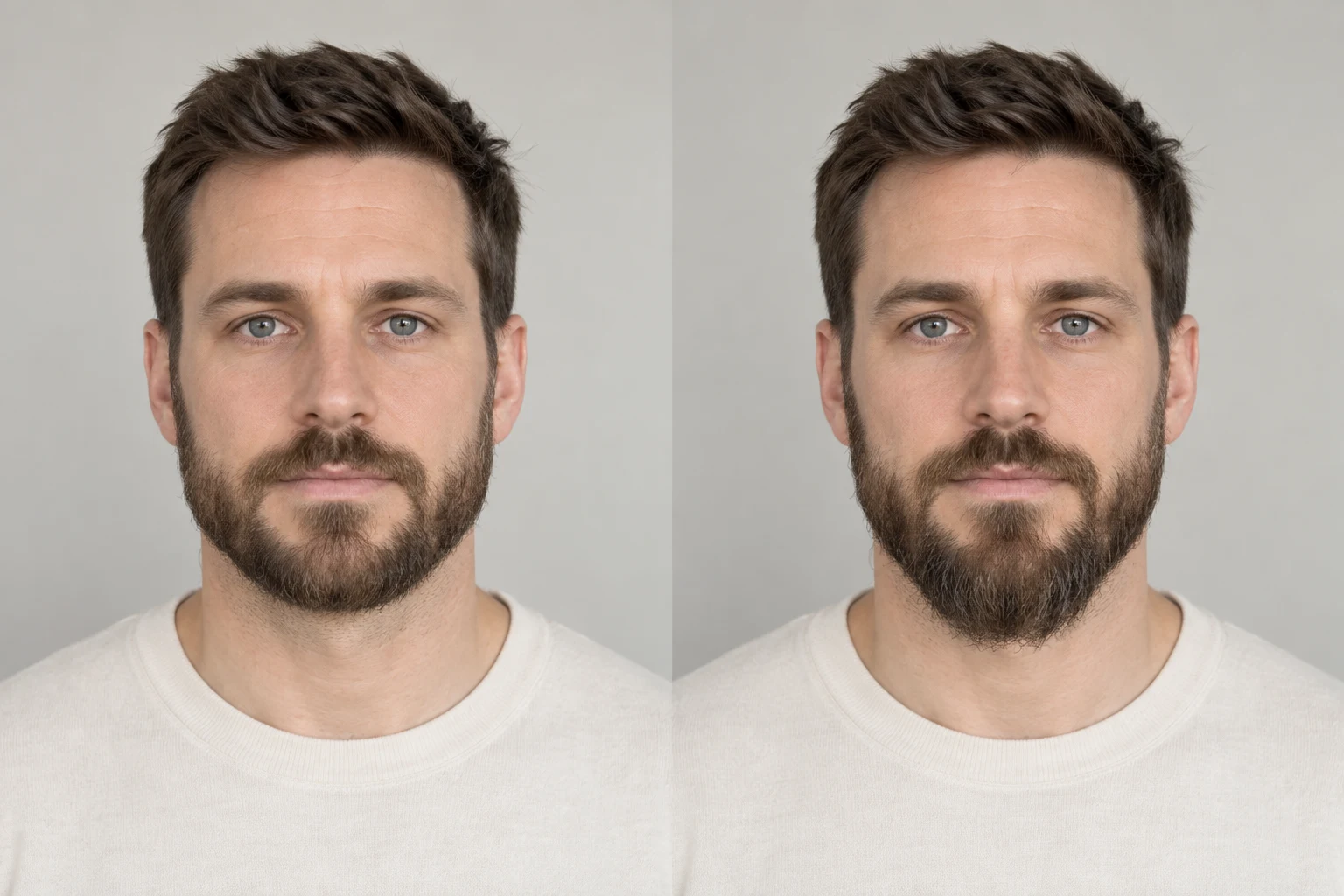
AI-generated editorial portraits · Styling examples, not transformation results
Longer facial hair adds to the visible lower-face silhouette. That is a framing choice. When comparing it, keep side coverage stable so you can tell what the extra length contributes to the full portrait.
In a relaxed front and side reference, identify where you see the natural outline and where hair covers it. Use that distinction when describing definition. A newly trimmed boundary is a grooming change, even when it makes the lower-face edge easier to read.
Extra beard length beneath the chin extends the outer silhouette downward. Extra side bulk adds width. If you want to test one, hold the other steady. Ask a barber which contour is realistic with your growth, including sparse areas you prefer to preserve.
A clear brief names the outline you want to maintain without turning a generic internet line into a rule for every face. Use the existing coverage as your starting point. Check the entire portrait after the trim and include comfort and maintenance in the review.
A cheek line, neckline and sideburn transition create different edges around the face. Decide which boundary needs attention instead of sharpening every line automatically. Your preferred effect might be a lighter lower frame, a cleaner connection to the haircut or a more continuous beard silhouette. The right outline depends on the coverage and finish you can maintain.
Look at the full portrait and profile before choosing the change. A boundary can seem precise in a crop yet create more visual length or contrast in the whole face than you wanted. Use the actual growth pattern as the starting point and ask a barber how the reference can be adapted rather than assuming every generated edge is realistic.
The closest-looking finish is not the only useful outcome. Record the tool, frequency and products involved in your grooming. If the skin is repeatedly uncomfortable, the plan needs to acknowledge that instead of prioritizing a photographically sharp boundary. Persistent concerns belong with an appropriate qualified professional.
Choose a routine you can repeat between trims. Keep the beard shape, maintenance sequence and comfort note together. A simpler outline may give you a more consistent lower-face frame in ordinary life than a highly polished version that needs constant work. Evaluate the daily version, including how it looks after a normal day.
Extra chin length and extra side fullness affect different dimensions. If you want less vertical emphasis, compare chin coverage while preserving side weight. If you want a narrower lower frame, compare side bulk while preserving chin length. Keep the camera and haircut familiar.
Finish the test with a trim note you can reuse. Explain what stayed, what changed and why you prefer the result. That record turns grooming into a precise framing decision instead of a recurring search for a stronger-looking beard.
| Variable | What the comparison answers |
|---|---|
| Chin length | How much visible length do I want below the chin? |
| Side bulk | How broad should the lower-face silhouette appear? |
| Boundary | Which edge works with my coverage and upkeep? |
| Transition | How should the beard connect with the haircut? |
Describe the silhouette you want to compare before naming a beard style. If the concern is length, mark the lowest beard edge in a neutral reference. If the concern is width, look at both sides of the front view. Keep the goal about a visible dimension so your barber can explain the practical adjustment.
After the trim, recreate the original front and profile references. Do not combine the comparison with a new haircut or a dramatic side light. Record which boundary changed and how the new outline relates to the rest of the face. Save the length and maintenance instructions alongside the photos.
Keep the cheek line and side coverage. Reduce the extra length under the chin. Compare the full front view and profile before deciding whether the sides also need attention.
Adding length at the chin and removing side width at the same time, then being unable to tell which change affected the balance.
Write one contour to keep and one dimension to change. Compare the same front and profile views before adjusting anything else.
Make the next trim answer a lower-face question.
Compare less length beneath the chin without changing the side coverage.
How does the resulting lower-face outline relate to the upper face?
No account or upload. Notes stay on this page; download them before leaving.
That depends on your preferred lower-face outline and growth pattern. More side bulk can add width; more chin hair can add length. Compare the dimension you actually want to change.
Use it to describe the silhouette, then adapt it to your real coverage with a barber. The image may assume hair where your current growth is different.
The silhouette supports your preference, the skin remains comfortable and the upkeep fits your normal week. Keep front and profile references with a brief maintenance note.
Compare stubble and beard contours for looksmaxxing. Assess chin length, side bulk and coverage against the balance of your whole face.
Understand jawline definition, chin and profile balance, beard framing and mewing claims before choosing your next looksmaxxing step.
Understand facial thirds, midface, symmetry and profile balance. Learn what a face analysis can show and how to use it in looksmaxxing.